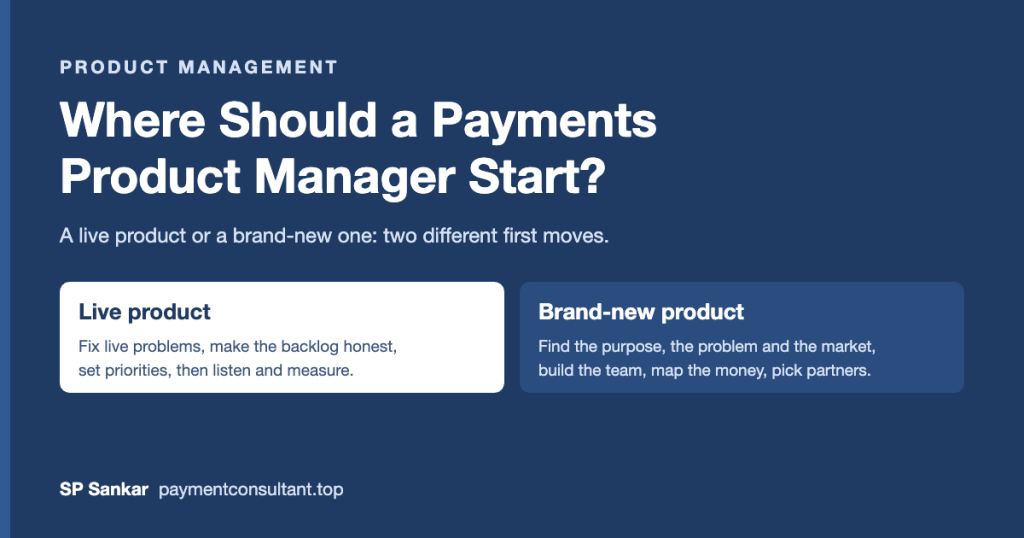
Every new payments product manager asks the same question in week one: where do I start? I asked it too. The answer depends on one thing. Is the product already live, or brand new?
If the product is live, fix what hurts, tidy the backlog, plan, then check it worked. If it is new, know why, know who it is for, build the right team, and launch small and safe.
Part 1: The product is already live
Week one: purpose and people
- Learn why the product exists and how its success is measured.
- Meet the team, and the people in operations, support, compliance and finance. They know where it hurts.
- Find out who decides what.
1. Fix live problems first
Failed, stuck or double payments, broken checks, and numbers that don’t match come first: fix them now. Problems with a workaround get a plan. Small annoyances go on the to-do list. Look for problems that keep coming back, because fixing those pays off most.
2. Make the backlog honest
The backlog (the team’s to-do list) is often full of old ideas and duplicates. Collect requests from sales, support and compliance in one place, delete what is no longer needed, and label the rest: must do, fix or new feature.
3. Set priorities
- Deadlines first: rules from regulators and card networks, expiring certificates, security fixes.
- Then risk and customer harm: the biggest problems from step 1.
- Then value against effort: new features that move one important number. Check what competitors offer too.
- A little clean-up every sprint, so old code doesn’t pile up.
A simple way to split each sprint (a two-week work cycle):
| Type of work | Share of the sprint |
|---|---|
| Work with a deadline | Whatever the date needs (plan it first) |
| Live problems | About 20% |
| Clean-up and security | About 10 to 15% |
| New features | The rest |
4. Listen and measure
After each release, check whether it helped. Two things tell you:
- Customers: support tickets, complaints, short interviews, and where people give up in the app.
- Numbers: pick three to five, such as payment success rate, time for the money to arrive, returned payments, fraud losses and cost per payment.
Look at them every week. Turn the biggest gap into new backlog items, and tell customers when their problem is fixed. Then the loop starts again.
Part 2: The product is brand new
There are no live problems and no data yet. So the question becomes: what must be true before the first dollar moves?
| Area | Live product | New product |
|---|---|---|
| Start with | Problems hurting customers today | The purpose and the customer |
| Decide with | Data from production | Customer interviews and a small pilot |
| The team | A team you get to know | A team you build |
| Biggest risk | Breaking what works | Building the wrong thing |
1. Find the purpose
Why should the company build this, and why now? Write it in one sentence, for example: “Help small clinics get paid the same day.” Agree what success looks like, and find a senior sponsor who makes the final call.
2. Start with the problem and the market
Talk to 10 to 15 target customers. Learn how they pay today, who else offers this, why they would switch, and what they would pay. Then write one sentence on why a customer would choose you. If you can’t, keep researching.
3. Build the right team
Start with five to eight people: a product manager, an engineering lead, someone with deep payments experience, quality engineering and a designer, plus partners from compliance, operations and finance. Agree early who decides what.
4. Draw the money flow with compliance
Who holds the money, which rail (ACH, wire, card or instant), and which rules apply? Bring compliance and risk in now, not the week before launch.
5. Choose partners early
Most new payment products need a sponsor bank (a licensed bank that gives you access to the payment networks) and a processor. Their onboarding and tests often take longer than building the product, so start them first.
6. Plan the unhappy paths
Decide what happens when a payment is returned, sent twice, times out or is disputed, and how your records will match the bank’s. In payments, this is half the product.
7. Build the first backlog
In this order: approvals and contracts, then checks (identity, sanctions and fraud), then one complete payment from start to finish, then tools for the support team. Everything else waits.
8. Get go-to-market ready
Sales, marketing and support must know who the product is for and what it does. In payments, compliance approves every promise: words like “instant”, “free” or “FDIC-insured” must be exactly true.
9. Launch small and safe
One customer type, one rail, low limits and a few friendly pilot customers. Keep a switch that stops new payments fast if something goes wrong. Talk to pilot customers every week, and grow only when the numbers look healthy.
10. Listen, measure, improve
Once real payments flow, the new product is a live product. From here, follow Part 1.
The short version
Live product: fix, tidy, plan, then listen and measure. Repeat every sprint.
New product: why, who it is for and which team; then money flow, partners and what can go wrong; then a small, safe launch.
Where did you start, on a live payments product or a brand-new one?
Working on a payments project?
I help banks and fintechs deliver real-time payments, ISO 20022, and AI-driven AML and compliance change, from strategy to go-live.
Connect on LinkedInSee how I can help