⏱ 2-minute read · open “Read more” for the details
Today, most businesses take payments through the software they already use: a salon’s booking app, a restaurant’s till system, an online store builder. That’s embedded payments: payments built into software from a company that isn’t a payments company.
Embedded payments means a software company that is not a bank, like Shopify or Uber, lets you pay inside its own app and earns money from each payment. This post explains how it works and who earns what.
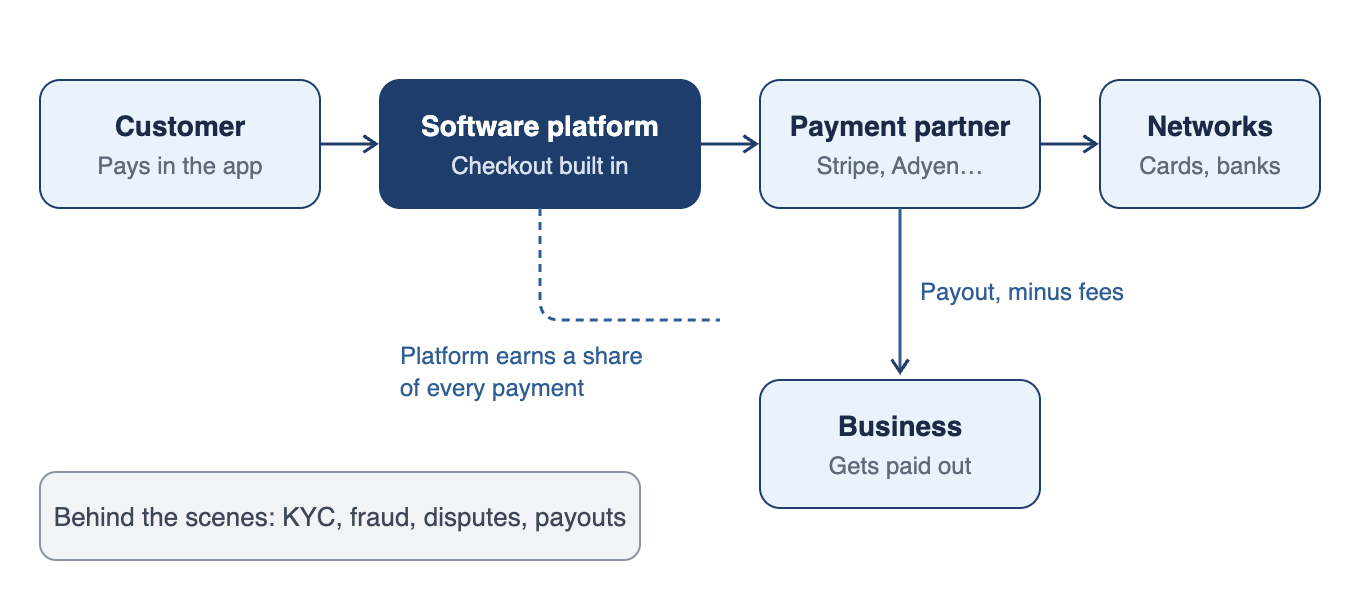
Start at the left. The customer pays inside the app. A payment partner and the card networks move the money. The business gets paid, and the platform earns a small share.
Why platforms do it
Meet Lucy. She runs a hair salon and takes bookings in a salon app. When a client pays in that app, the app company earns a small share. That is embedded payments.
- Revenue: a share of every payment.
- Loyalty: payments, payouts and reports in one place, so users stay.
- Simplicity: one sign-up, one dashboard, faster money.
- Data: sales data opens the door to lending and insights.
Real examples, in numbers
Big platforms already do this at huge scale.
- Shopify, Toast, Uber and Meta all build payments into their apps.
- Where payments sit at the heart of daily work, they can become the biggest part of the business.
Read more: Real examples, in numbers
Companies rarely report “profit from payments” on its own, but their results show how big embedded payments has become. All figures are for the full year 2025.
| Company | What it embeds | The numbers |
|---|---|---|
| Shopify | Shopify Payments and Shop Pay inside its online store builder | Merchant solutions, which are mostly payments, brought in $8.8 billion, about 76% of Shopify’s $11.6 billion revenue. 65.6% of all sales on Shopify, or $248 billion, ran through Shopify Payments. Operating income: $1.5 billion. |
| Toast | Payments built into its restaurant point-of-sale system | Processed $195 billion in payments across about 164,000 locations. Software plus payments gross profit reached about $1.9 billion, and net income was $342 million. |
| Uber | Riders pay in the app; drivers and couriers are paid out automatically | $193 billion in gross bookings and $52 billion in revenue, with adjusted EBITDA (profit before interest, tax and some accounting costs) of $8.7 billion. Uber doesn’t report payments separately, but every one of those trips depends on payments built into the app. |
| Meta (Facebook and Instagram) | Checkout inside Facebook and Instagram Shops | The opposite lesson: in 2025 Meta moved Shops to checkout on the seller’s own website and stopped processing payments for Shops. Embedded payments isn’t right for every platform; Meta chose to focus on advertising. |
The pattern: where payments sit at the heart of the user’s daily work, like a store, a restaurant or a ride, embedded payments can become the biggest part of the business. Where they don’t, it may not be worth the risk and effort.
Who earns what: card networks and PayPal
Every card payment carries a small fee, shared between several players.
- Most goes to the customer’s bank.
- The card network, the payment partner and the platform share the rest.
- At huge scale, those small fees add up to billions.
Read more: Who earns what: card networks and PayPal
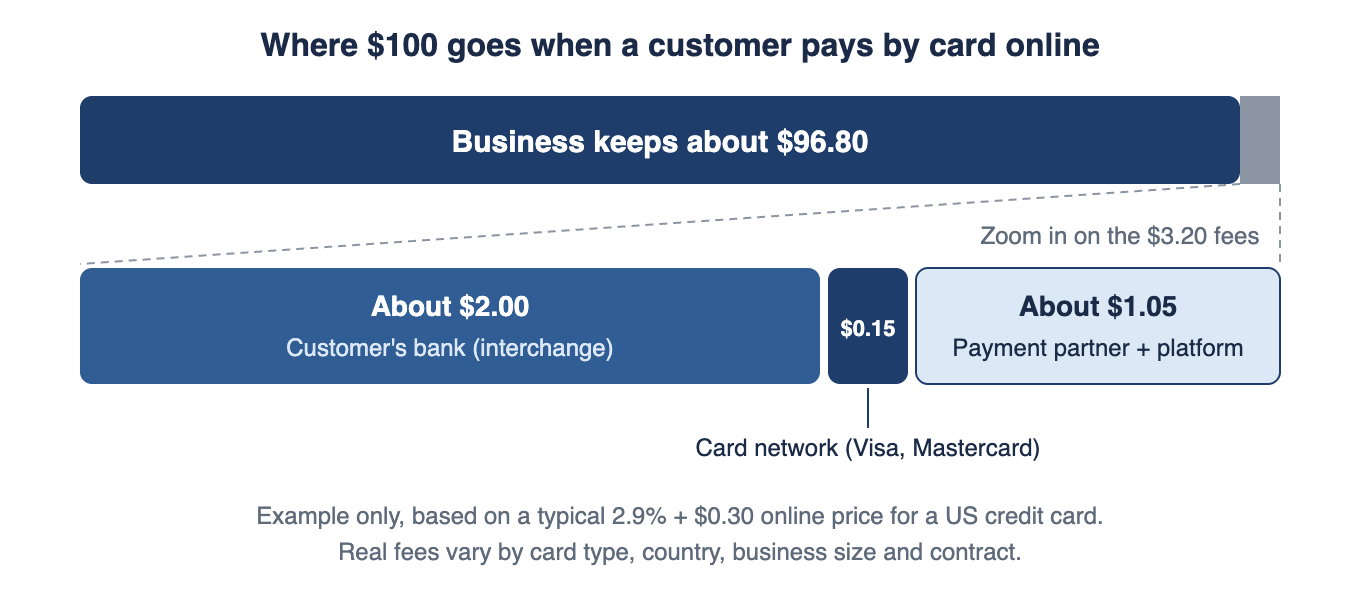
In one sentence: every card payment carries a small fee, shared between the customer’s bank, the card network, the payment partner and the platform. At huge scale, those small fees add up to billions.
The long dark bar is the $100 the customer paid. Almost all of it goes to the business. The small gray piece on the right is the fee. The row below zooms in on it. The biggest share goes to the customer’s bank, a tiny slice goes to the card network, and the rest goes to the payment partner and the platform. These are example amounts, not exact prices.
Here is what each company earned in its last full year:
| Company | How it earns | Revenue | Net profit |
|---|---|---|---|
| Visa | A small fee for running the network on every payment. It doesn’t lend money. | $40.0 billion | $20.1 billion |
| Mastercard | Same model as Visa: network fees plus extra services such as fraud tools and data | $32.8 billion | $15.0 billion |
| American Express | Runs the network and usually issues the card too, so it earns merchant fees, card fees and interest on loans | $72.2 billion | $10.8 billion |
| Capital One | Mostly a card-issuing bank: interest on card and car loans, plus card fees. Since buying Discover in May 2025 it also owns a card network. | $53.4 billion | $2.5 billion |
| PayPal | Fees on PayPal, Venmo and card processing for businesses | $33.2 billion | $5.2 billion |
Visa’s figures are for its fiscal year ending September 2025; the others are for calendar 2025.
Why the profits look so different: Visa and Mastercard keep about half their revenue as profit, because they only run the network. They don’t lend money or take on bad debts. American Express earns more but keeps less, because it also lends to cardholders and spends a lot on rewards. Capital One had the most revenue on the list but the smallest profit in 2025. It set aside $20.7 billion for loans that may not be repaid, and paid one-time costs to merge with Discover.
How one payment flows
Here is what happens when Lucy’s client taps Pay.
- In seconds: the payment is checked and approved.
- Over the next days: the money settles and reaches Lucy.
- The salon app never talks to Visa or Mastercard directly. Its payment partner does.
Read more: How one payment flows
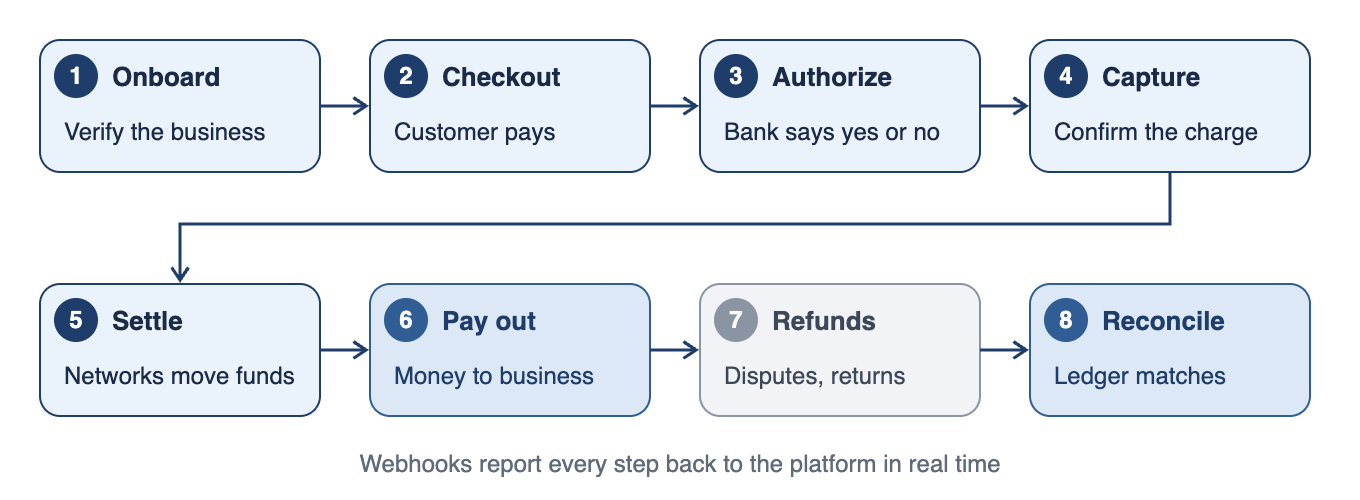
Follow the numbers 1 to 8. The top row happens in seconds. The bottom row happens over the next days. Dark blue is a normal step, lighter blue is money arriving, and gray is money going back.
The card brand is spotted from the first digits: 4 is Visa, 51–55 or 2221–2720 is Mastercard, 34 or 37 is Amex. The platform never talks to Visa or Mastercard directly; its payment partner does.
Three ways to build it
The app company can build this in three ways.
- Referral: send businesses to a provider. Low earnings, low risk.
- Payment facilitator: sign businesses up under its own account. More earnings, more risk.
- Most platforms start in the middle.
Read more: Three ways to build it
| Model | In short | Earns | Risk |
|---|---|---|---|
| Referral | Send businesses to a provider | Low | Low |
| Payment facilitator (PayFac: a company that signs up businesses to take cards under its own account) as a service | Use a partner such as Stripe Connect, Adyen for Platforms or PayPal under your brand | Medium | Shared |
| Full payment facilitator | Run sign-up checks (onboarding), risk and payouts (paying the businesses) yourself | High | All yours |
Ways to pay, on every channel
Lucy’s clients can pay however they like.
- Cards, wallets, PayPal and Pay Later.
- On the web, in apps, and in person with Tap to Pay.
- Every sale lands in one ledger and one payout.
Read more: Ways to pay, on every channel
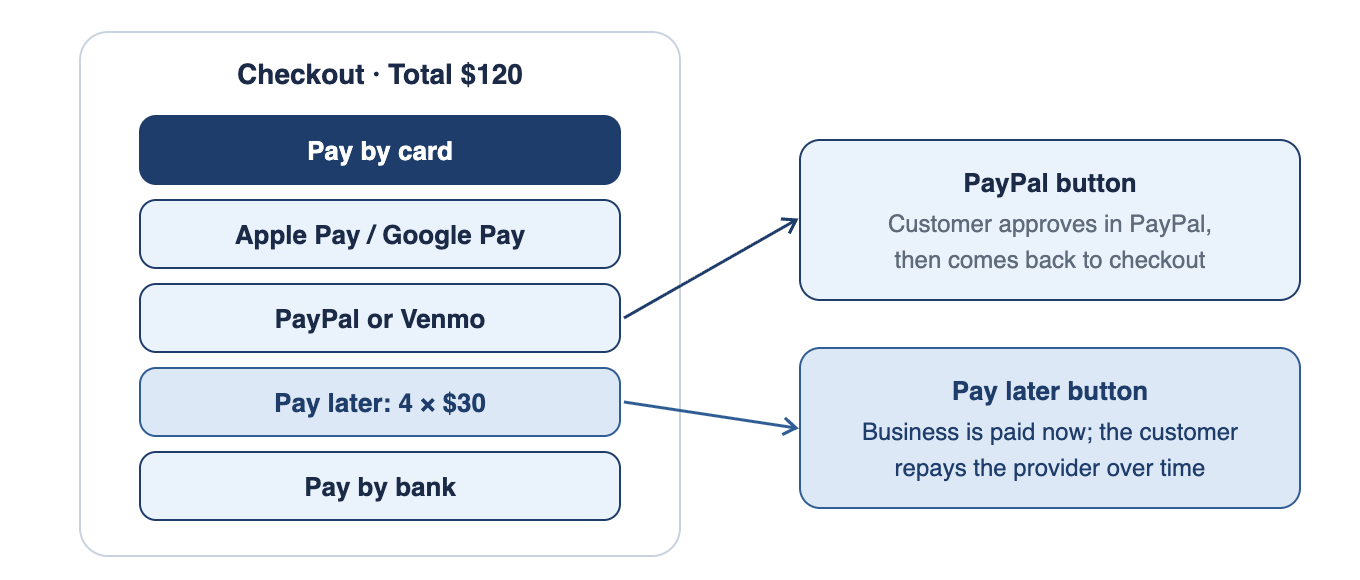
The checkout on the left offers five ways to pay. With PayPal, the customer approves in PayPal and comes back. With Pay Later (buy now, pay later), the business is paid now and the customer pays back over time.
The same setup works on the web, iPhone and Android apps, and in person with Tap to Pay, and every sale lands in one ledger and one payout.
The settings that matter
A few settings shape the whole experience.
- How businesses sign up, and how much checking happens.
- Which payment methods to offer.
- Fees, payout timing, and fraud rules.
Read more: The settings that matter
| Area | What to decide |
|---|---|
| Onboarding | Hosted or your own screens; how much KYC (know your customer: checking who a customer really is) up front |
| Payment methods | Cards, wallets, PayPal, Pay Later, bank payments |
| Money rules | Platform fee, payout schedule, instant payouts |
| Subscriptions | Retries and reminders for failed renewals |
| Risk | Fraud rules, reserves (money held back in case of refunds or fraud), who handles disputes |
| Data | Webhooks (automatic messages from the payment partner), ledger (your record of who is owed what), daily reconciliation (checking that every record matches) |
Watch out for
Embedded payments bring bank-like risks.
- Sign-up: too strict loses customers; too loose lets fraud in.
- Disputes and refunds become your problem.
- Compliance and reconciliation need real discipline.
Read more: Watch out for
- Onboarding: too strict loses customers; too loose lets fraud in.
- Compliance: card rules, AML (anti-money-laundering checks), PCI and lending rules.
- Reconciliation: Finance must trust the numbers.
My take
Embedded payments turn software companies into payment companies. The best ones make paying feel invisible, and run the risk and reconciliation behind it with the discipline of a bank.
Working on a payments project?
I help banks and fintechs deliver real-time payments, ISO 20022, and AI-driven AML and compliance change, from strategy to go-live.
Connect on LinkedInSee how I can help