⏱ 4-minute read · open “Read more” for the details
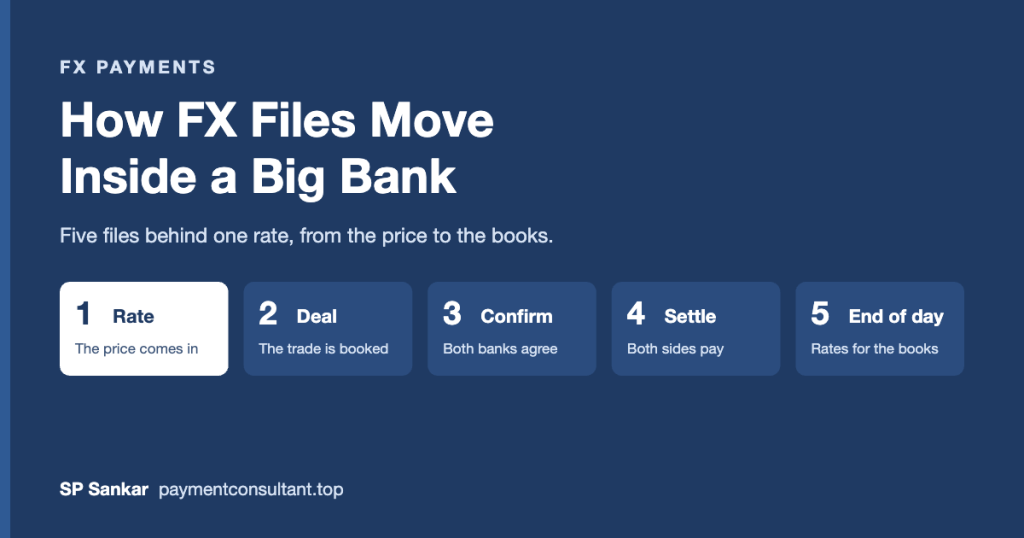
Meet Anna. She runs payments at a machine maker in Munich. Today she pays one supplier in India €100,000, and the supplier gets rupees. Anna sees one rate on her screen and taps Send. Behind that one rate, five FX files move inside her bank and between banks. Let’s follow them.
- New to banking? Read the top of each step. That’s the whole story.
- Work in a bank? Open “Read more”.
- Engineer or tester? Look for the “For tech readers” boxes.
The same five checks for every file
Every FX file in a big bank is checked the same way before anyone acts on it. Learn these once and the rest is easy.
- Real sender: it came from a system or bank we trust, and nobody changed it.
- Right format: every field is where it should be.
- Not a duplicate: the same file or deal is never used twice.
- Totals match: the count and amounts add up.
- Rate makes sense: it’s fresh and close to the market.
Read more: The same five checks for every file
For tech readers: Real sender = signed and encrypted transport (mutual TLS, PGP or SWIFT PKI). Right format = schema validation. Not a duplicate = an idempotency key such as the file ID or trade ID. Totals match = control count and control sum. Rate makes sense = a staleness limit plus a tolerance band against other price sources. Anything that fails goes to an exceptions queue with a reason code, never silently dropped.
1. Rate file: the price comes in
Market prices flow into Anna’s bank many times a second. The bank turns them into the rate Anna sees on her screen.
- Prices come from data companies such as LSEG and Bloomberg, and from other banks.
- A price that is too old, or far away from the others, is thrown out.
Read more: Rate file
- The bank’s pricing engine builds one middle rate and adds its margin for Anna’s type of customer.
- Her quote gets an ID and a short expiry, so the bank books exactly the rate she accepted.
For tech readers: Live prices usually arrive as streams (FIX or the vendor’s own feed), with snapshot files for back-up and end of day. The rate service publishes quotes with a quote ID and time-to-live to every channel.
2. Deal file: Anna’s trade is booked
When Anna taps Send, the bank books an FX deal: her euros for rupees. A deal file carries that trade to the payment, risk and accounting systems.
- It says who, which currencies, how much, which rate and which day.
- The deal must match the rate Anna accepted, and must never be booked twice.
Read more: Deal file
- The deal number links Anna’s payment to the trade, so anyone can trace one from the other.
- The risk system updates the bank’s open rupee position straight away.
For tech readers: The trading system publishes a trade event (often over a message queue) with trade ID, currency pair, both amounts, rate, value date and customer. Consumers process it once per trade ID, and the payment hub and FX system are reconciled daily.
3. Confirmation: both banks agree
Anna’s bank buys the rupees it needs from another bank. Both banks then send a confirmation that must say exactly the same thing.
- Same amount, same rate, same day. If they match, the deal goes ahead.
- If they don’t, people fix it before any money moves.
Read more: Confirmation
- The bank doesn’t buy rupees for each customer one by one. It adds up all its customers’ deals and trades with other banks a few times a day.
- Anna gets her own confirmation of the deal from her bank.
For tech readers: Interbank FX confirmations are MT300 or the ISO 20022 equivalent (fxtr.014), matched automatically on trade date, value date, currencies, amounts, rate and settlement instructions. Unmatched trades are flagged straight away.
4. Settlement: both sides pay
Now the money really moves. Anna’s bank pays euros, the other bank pays rupees, and Anna’s supplier is paid from the bank’s rupee account in India.
- Settlement files tell each bank exactly what to pay, to which account and on which day.
- Each bank checks that it received its side before the deal is closed.
Read more: Settlement
- Many currencies settle through CLS, which pays both sides at the same moment. The rupee isn’t a CLS currency, so euro-rupee deals settle through each bank’s own accounts.
- That creates a short risk: one bank pays and the other doesn’t. Banks manage it with limits on how much they can owe each other.
For tech readers: Bank-to-bank legs go as MT202 or pacs.009 using agreed standard settlement instructions. Anna’s payment goes as a pacs.008 over SWIFT. Nostro accounts are reconciled against camt.053 statements.
5. End of day: one set of rates for the books
At the end of the day, the bank sends one agreed set of rates and its open FX positions to accounting, risk and, where required, regulators.
- Every team values the books with the same rates, so the numbers match.
- All of today’s deals must be included, and the totals must match the trading system.
Read more: End of day
- Banks often use an official benchmark, such as the London 4pm rate or the ECB’s daily rates.
- Any difference between systems, called a break, is investigated before the books close.
For tech readers: An end-of-day rate file and position file feed the general ledger and risk engines. Deal counts and amounts are reconciled across trading, payments and accounting, and breaks are tracked to closure.
What can go wrong
| Problem | Which file | What happens |
|---|---|---|
| Old or odd price | 1. Rate | Blocked before any customer sees it. |
| Deal booked twice | 2. Deal | The second one is stopped. |
| Banks’ confirmations differ | 3. Confirmation | Held until people fix it. |
| One side not paid | 4. Settlement | The settlement team chases it the same day. |
| Totals don’t match | 5. End of day | Investigated before the books close. |
My take
Anna saw one rate and tapped once. Behind it, five files carried the price, her deal, the banks’ agreement, the money and the day’s final numbers. Each one passed the same five checks. That is FX inside a big bank.
Working on a payments project?
I help banks and fintechs deliver real-time payments, ISO 20022, and AI-driven AML and compliance change, from strategy to go-live.
Connect on LinkedInSee how I can help