⏱ 4-minute read · open “Read more” for the details
Meet Jake. He runs a machine parts company in Houston. Today he is sending $50,000 to a supplier in Stuttgart, Germany. In his bank’s system, the supplier’s whole address sits in one long line of free text. That has worked for years. Under the new rules it no longer will.
For tech readers: Under Swift’s ISO 20022 rules, cross-border messages move from free-text address lines to structured or hybrid postal addresses (in pain.001 and pacs.008). Fully unstructured addresses are being phased out; the dates are in the timeline below.
Latest update: on 27 August 2026, Swift postponed the removal of free-text addresses that was planned for 14 November 2026. It will announce a new timeline by December 2026 at the latest. The Federal Reserve moved its Fedwire release to 22 November 2027. That release adds the hybrid format, but it does not remove free-text addresses yet. The Fed will set that date later. The direction hasn’t changed: free-text addresses are going away, so keep preparing.
Banks must stop sending addresses as one free-text line in cross-border payments and use separate, labeled fields instead, like filling in a form rather than writing a note. This post explains what changes and when.
ISO 20022 is changing how addresses are written in payments. In cross-border payments on Swift (known as CBPR+, SWIFT’s rules for cross-border payments in ISO 20022), fully free-text addresses are being phased out. Where an address is given, it must be either fully structured or hybrid, with the town and country in their own fields.
It looks like a small formatting change. It isn’t. Banks, corporates, fintechs, payment processors, ERP (a company’s main finance and operations system) and treasury systems, onboarding platforms and sanctions-screening tools all need to check how they capture, store, check and send address data.
Why address structure matters
Jake’s supplier’s address sits in one long line of free text. That has worked for years. Here is why it now matters.
- Free text is hard for machines to read.
- Screening tools can mix up street names with names on watch lists.
- Structured addresses put each part in its own box.
Read more: Why address structure matters
For years, payment systems stored addresses as free text, like this:
John Smith
55 Mark Ave
New York 10001
United States
A person reads that easily. A computer often can’t tell which part is the street, the postal code, the town or the country. ISO 20022 fixes this by giving each part its own field. That makes payments faster and more automatic, and it helps sanctions screening, fraud checks and reporting.
The industry is moving step by step: free text → hybrid → fully structured.
Where the industry is today
Jake isn’t alone. Much of the industry still uses free text.
- In June 2026, about six in ten cross-border payments still used free-text addresses.
- That gap is the main reason the deadline was postponed.
Read more: Where the industry is today
Swift’s own data for June 2026, covering cross-border customer payments, shows how much work is left:
| Party | Fully structured | Hybrid | Unstructured | No address |
|---|---|---|---|---|
| Debtor (who pays) | 23.5% | 11.7% | 60.1% | 4.7% |
| Creditor (who gets paid) | 18.5% | 6.4% | 61.4% | 13.8% |
About six in ten payments still used free-text addresses. That gap is the main reason the deadline was postponed.
For tech readers: Unstructured uses AdrLine only. Hybrid requires TwnNm and Ctry and allows up to two AdrLine lines. Fully structured uses StrtNm, BldgNb, PstCd, TwnNm, Ctry and related fields.
The three address formats
Jake’s bank can send the address in three ways.
- Unstructured: one long free-text line. This is being phased out.
- Hybrid: free text plus a separate town and country. This is the bridge.
- Fully structured: every part in its own field. This is the best choice.
Read more: The three address formats
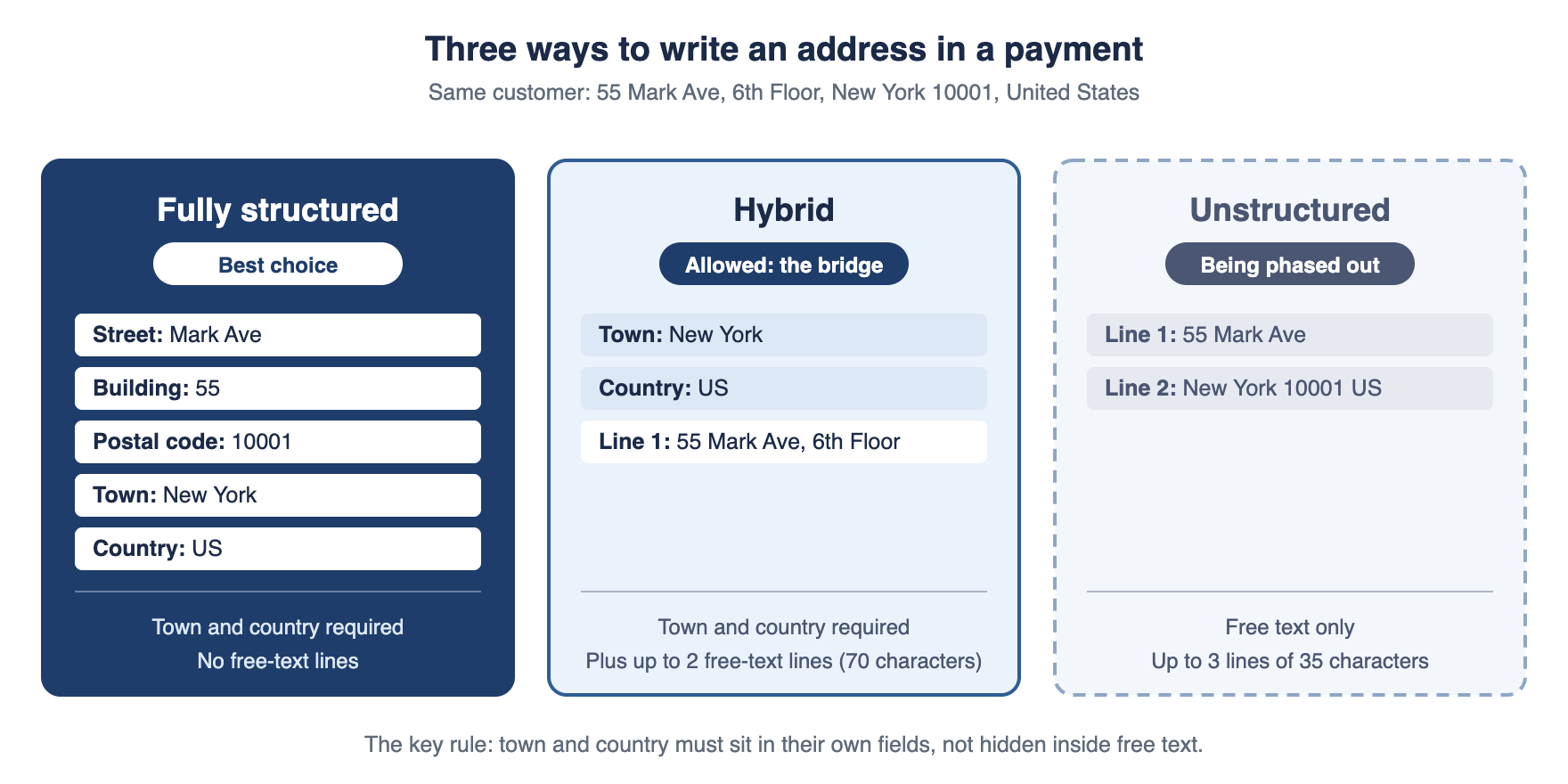
Each card shows the same customer address. The dark card on the left is the best choice: every part has its own field. The middle card is the hybrid “bridge”: town and country get their own fields, and the rest can stay as free text. The dashed card on the right is the old free-text style that is being phased out.
| Format | The rules | Status |
|---|---|---|
| Fully structured | Every part in its own field. Town and country are required at a minimum. No free-text address lines allowed. | Recommended |
| Hybrid | Town and country in their own fields, plus up to two free-text lines of up to 70 characters each | Allowed: the bridge for older data |
| Unstructured | Free text only, in up to three lines of 35 characters | Being phased out (new date to be announced) |
Fully structured example:
For engineers: the technical detail below is optional; the rest of the post makes sense without it.
<PstlAdr>
  <StrtNm>Mark Ave</StrtNm>
  <BldgNb>55</BldgNb>
  <PstCd>10001</PstCd>
  <TwnNm>New York</TwnNm>
  <Ctry>US</Ctry>
</PstlAdr>
Hybrid example:
<PstlAdr>
  <TwnNm>New York</TwnNm>
  <Ctry>US</Ctry>
  <AdrLine>55 Mark Ave, 6th Floor</AdrLine>
</PstlAdr>
Unstructured example (being phased out):
<PstlAdr>
  <AdrLine>55 Mark Ave</AdrLine>
  <AdrLine>New York 10001 United States</AdrLine>
</PstlAdr>
A few non-payment messages are exempt from the rule: admi.024, camt.025, camt.052, camt.053, camt.054 and camt.060.
The one rule to remember: town and country must be separate, structured data, not words buried inside a free-text line.
The timeline: what changed
Here is when things change.
- November 2025: the hybrid format arrived.
- August 2026: Swift postponed the November 2026 deadline.
- 12 June 2027: Swift’s delayed release goes live.
- 22 November 2027: Fedwire adds the hybrid format.
Read more: The timeline: what changed
Read the line from left to right. Hybrid addresses arrived in November 2025. The original deadline of 14 November 2026 (the dashed circle) was postponed in August 2026. Swift will announce the new date by December 2026. Fedwire’s next release, on 22 November 2027, adds the hybrid format but keeps free-text addresses for now.
- November 2025: the hybrid address format (town and country in their own fields, the rest free text) became available in CBPR+ messages.
- 27 August 2026: Swift postponed all payments changes planned for November 2026, including the removal of unstructured addresses. The same day, the Federal Reserve moved its Fedwire release from November 2026 to November 2027.
- By December 2026: Swift will announce the new timeline after consulting banks, central banks and market infrastructures.
- 12 June 2027: Swift’s delayed release goes live for messages outside payments (securities, Tracker and investigations). It does not include the address change.
- 22 November 2027: Fedwire’s ISO 20022 release adds the hybrid format for all parties and agents. Free-text (unstructured) addresses are still allowed, and the Fed will set their end date later. The release also updates 10 message guides, including customer and bank transfers, returns and investigations.
Fedwire already requires the hybrid format for some parties, such as the ultimate debtor, initiating party, ultimate creditor and originator. Only the main parties were given more time.
For tech readers: Fedwire’s November 22, 2027 release adds the hybrid address format. CHAPS, SEPA and other systems follow their own timelines. The real change is in the customer and beneficiary master data that feeds every channel.
The impact is bigger than Swift
The address isn’t born in the Swift message. It is created much earlier, when Jake’s company first saves the supplier.
- Onboarding and customer records store it.
- ERPs, portals and the payment hub use it.
- Screening checks it, and the payment rail sends it.
Read more: The impact is bigger than Swift
A common mistake is treating this as just a Swift message change. The address is created much earlier in the payment’s journey:
- The customer or beneficiary gives an address
- Onboarding saves it in the customer master
- An ERP, treasury system or payment portal uses it
- The payment hub picks it up
- Validation and enrichment check it
- Compliance and sanctions screening review it
- The payment rail sends it to the receiving bank
If step 2 stores “55 Mark Ave, New York 10001 US” as one line, but step 7 needs Street = Mark Ave, Building = 55, Postal code = 10001, Town = New York and Country = US, someone or something must split it correctly. That’s why this work starts with clean data, not message formats.
Impact across payment channels
Every way Jake pays is affected.
- Online banking and portals need address fields for each part.
- APIs and files must carry structured data.
- Saved templates and recurring payments need updating.
Read more: Impact across payment channels
| Channel | What to check |
|---|---|
| ISO 20022 (pain.001, pacs messages) | Fill the structured address fields. Aim for fully structured, and use hybrid only where full data isn’t available yet. |
| Swift MT101 (a SWIFT message a company uses to ask its bank to pay) | The rule still applies, because the bank needs the address to make the payment. Use the “F” field options (for example fields 50F and 59F), where town and country have their own place. |
| Bank portals | Replace “Address line 1, 2, 3” with separate boxes for street, building number, postal code, town and country, with country-code checks. |
| Files, host-to-host, ERP and APIs | Even if the file format isn’t ISO 20022, make sure it carries enough address detail to build a valid payment. |
Customer impact
Banks can’t fix this alone. Jake’s company must clean up its own data too.
- Vendor records and beneficiary details.
- Payment templates and standing instructions.
- Recurring payments.
Read more: Customer impact
Banks can’t fix this alone. Corporate customers need to clean up their vendor master data, beneficiary records, payment templates, standing instructions and recurring payments, and provide at least the town and country for every payee. Banks should tell their high-volume customers early, especially those paying through ERP, treasury, host-to-host or MT101 channels.
For tech readers: Structured fields allow field-level sanctions screening and more precise country rules, which cuts false positives. They also support the payment transparency rules in FATF Recommendation 16.
Compliance and screening impact
Here is the good news for Jake: cleaner addresses mean fewer false alarms.
- Screening tools stop confusing street names with names on watch lists.
- Anti-money-laundering checks, fraud checks and monitoring get more accurate.
- Fewer payments are held for review.
Read more: Compliance and screening impact
Better address data makes AML (anti-money laundering) checks, sanctions screening, fraud detection and transaction monitoring more accurate. Screening the free text "123 Main St NY USA" is guesswork. Receiving Town = New York and Country = US as separate fields is clear. Fewer guesses mean fewer false alerts and fewer missed ones.
For tech readers: Start by profiling address data in the customer master and saved beneficiary templates. Add address parsing and cleansing, update channel screens to capture structured fields, then regression-test the pain.001 to pacs.008 mapping end to end.
What to do now: an 8-step plan
Jake’s bank has work to do, and so does yours. Here is the plan in short.
- Find and assess every system that holds addresses.
- Clean the data and update every channel.
- Check addresses early, decide how to repair gaps, and test end to end.
- Tell customers early.
Read more: What to do now: an 8-step plan
- Discover: find every system that holds debtor, creditor, ultimate-party, agent, customer or beneficiary addresses.
- Assess: sort each one into fully structured, partly structured or free text.
- Cleanse: fix missing towns, wrong country codes, incomplete postal details and duplicates. Swift offers a free, open-source AI model that helps split free-text addresses into structured fields.
- Enhance channels: update portals, APIs (ways for systems to talk to each other), file formats and ERP links to capture structured data.
- Validate early: check addresses as close to payment entry as possible, not when the payment reaches Swift.
- Define repairs: decide what happens to an incomplete address: reject it, return it to the customer, or route it for repair.
- Test end to end: channel → payment hub → compliance → transformation → payment rail → receiving bank, including good, bad, boundary and rejection cases.
- Engage customers: share the requirements early, with clear examples.
Use the extra time wisely
The deadline moved, but it wasn’t cancelled.
- Don’t stop your project.
- Keep handling both formats.
- Watch for Swift’s new timeline, and use structured addresses now.
Read more: Use the extra time wisely
- Don’t stop your project. The deadline moved, but it wasn’t cancelled.
- Keep handling both formats. Incoming payments may carry free-text addresses for longer than planned, so don’t switch off your ability to process them yet.
- Watch for Swift’s December 2026 announcement and plan your final cut-over date as soon as it’s out.
- Use structured and hybrid addresses now. Both already work, and every payment you move early lowers your risk later.
One-page summary
Jake’s next payment goes out with each part of the address in its own box. It is quicker to screen and less likely to bounce. Here is the whole change on one page.
- What is changing, why it matters and what to do.
- In one line: keep addresses structured, from capture to send.
Read more: One-page summary
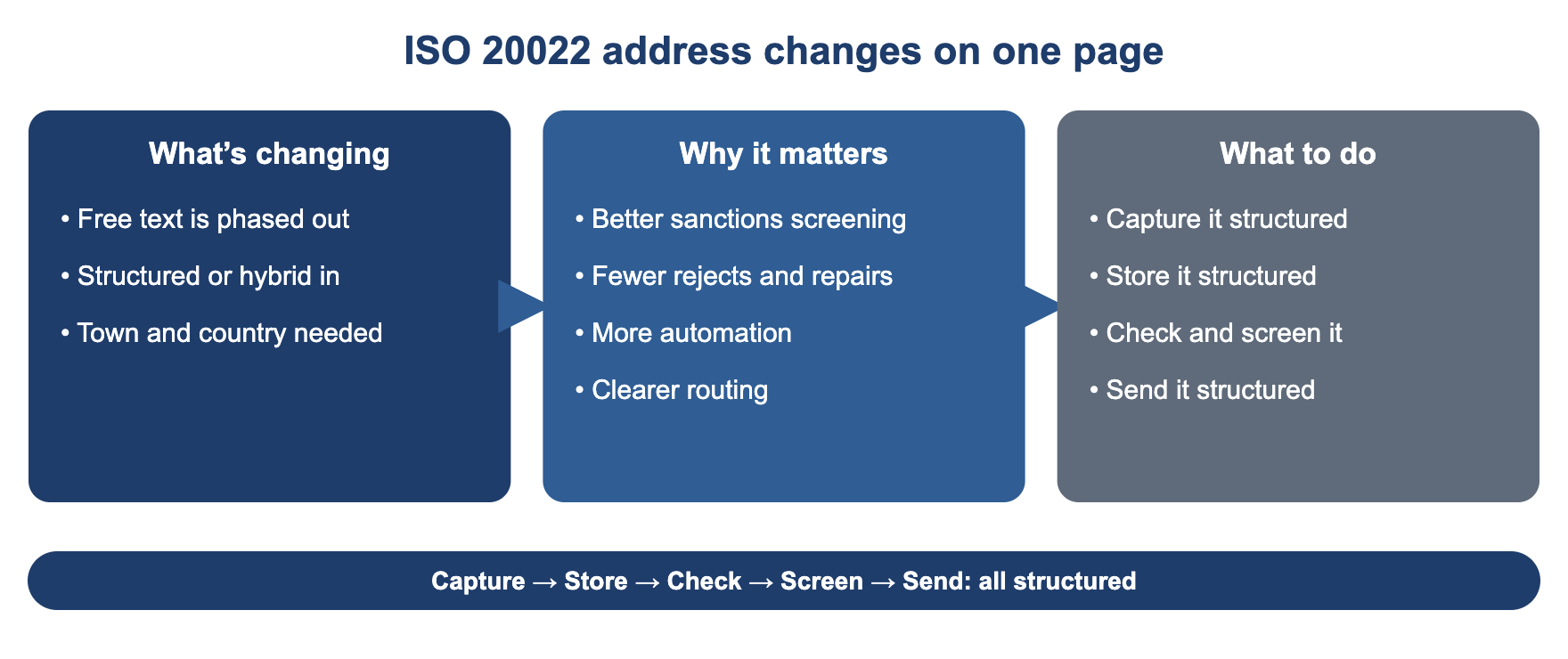
Read the three columns from left to right: what is changing, why it matters, and what to do. The dark bar at the bottom says it all in one line: keep addresses structured at every step, from capture to sending.
For tech readers: Treat structured addresses as a data-quality program, not just a message-format change. The message is the easy part; the data behind it is the real work.
My take
This change shouldn’t be treated as just another deadline. It’s a chance to fix a much bigger problem: poor-quality payment data. Splitting free text at the last moment solves one interface problem and leaves the real problem in place. The stronger path is:
Capture structured → Store structured → Check structured → Screen structured → Send structured
That means more automation, stronger compliance, fewer payment repairs and fewer failed payments.
This isn’t just an address-format change. It’s a payment data quality upgrade.
Working on a payments project?
I help banks and fintechs deliver real-time payments, ISO 20022, and AI-driven AML and compliance change, from strategy to go-live.
Connect on LinkedInSee how I can help