In my experience, most payment projects don’t fail because of technology. They fail because of surprises. A test with a partner that nobody booked. A guess about how fast another company’s system answers that nobody checked. A test environment that’s broken. Testing left too late. An audit problem nobody saw coming. None of these show up in the weekly status report until it’s too late.
A RAID log is one shared list of four things. Risks: what could go wrong. Assumptions: what you believe is true. Issues: what has already gone wrong. Dependencies: what you are waiting for from others. Look at it every week, and surprises turn into plans.
That’s why I keep a RAID log on every project.
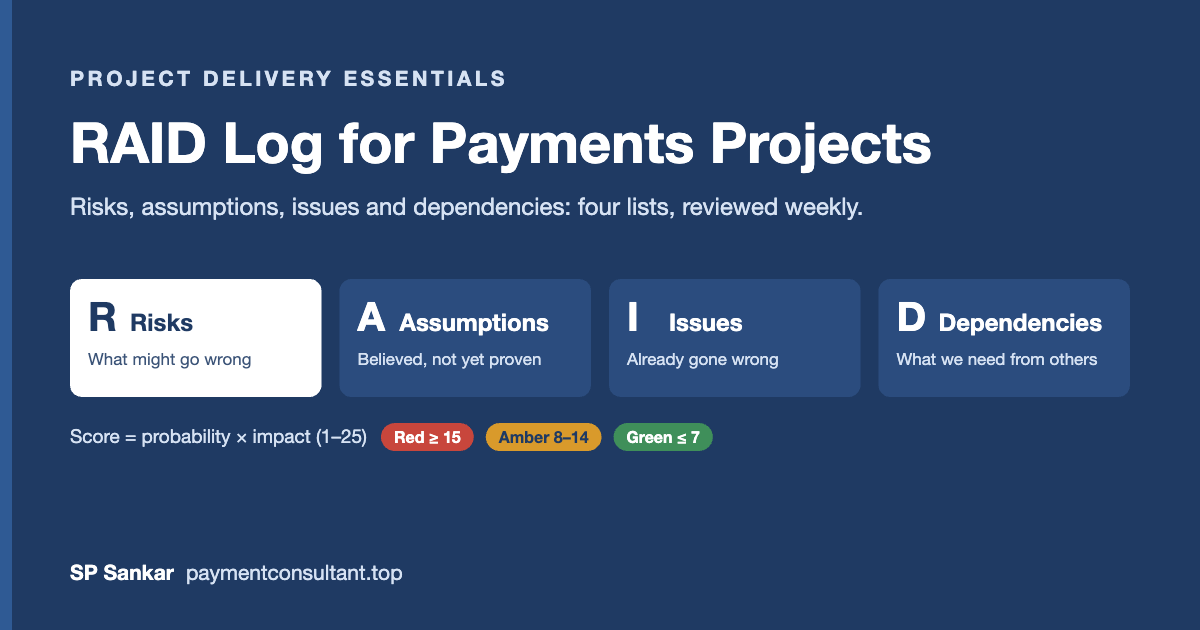
Each of the four tiles is one list, with the question to ask for it. The line under the tiles shows how to score a risk: how likely it is, times how bad it would be, from 1 to 25. Red is 15 or more, amber is 8 to 14, and green is 7 or less.
The four lists
| List | What goes in it | What to write down |
|---|---|---|
| Risks | What might go wrong | A score, who owns it, and how you’ll prevent it |
| Assumptions | What we think is true but haven’t checked | How and when we’ll check it |
| Issues | What has gone wrong | The fix, who owns it, and the date |
| Dependencies | What we need from others | Who delivers it, by when, and plan B if they’re late |
Payment examples
| Type | Example |
|---|---|
| Risk | The card company (like Visa or Mastercard) may not have a test slot for us before their deadline |
| Assumption | The partner bank’s system answers within two seconds, even on busy days |
| Issue | The test environment for business users has been down for a week |
| Dependency | The partner bank must give us test accounts before testing can start |
Three habits that make it work
- Look at it every week, not just before a big management meeting.
- Raise anything red straight away. A risk scoring 15 or more out of 25 shouldn’t sit quietly in a list.
- Link every item to a task in your team’s tracker (like Jira), so actions don’t get lost.
Free template
Get my RAID log template (Google Sheets, or download it as Excel). It has a simple dashboard, a color chart of risks and links to tasks.
Why I still keep one
In payments, deadlines set by card companies and regulators don’t move. A RAID log you look at every week turns surprises into plans.
Working on a payments project?
I help banks and fintechs deliver real-time payments, ISO 20022, and AI-driven AML and compliance change, from strategy to go-live.
Connect on LinkedInSee how I can help