⏱ 5-minute read · open “Read more” for the details
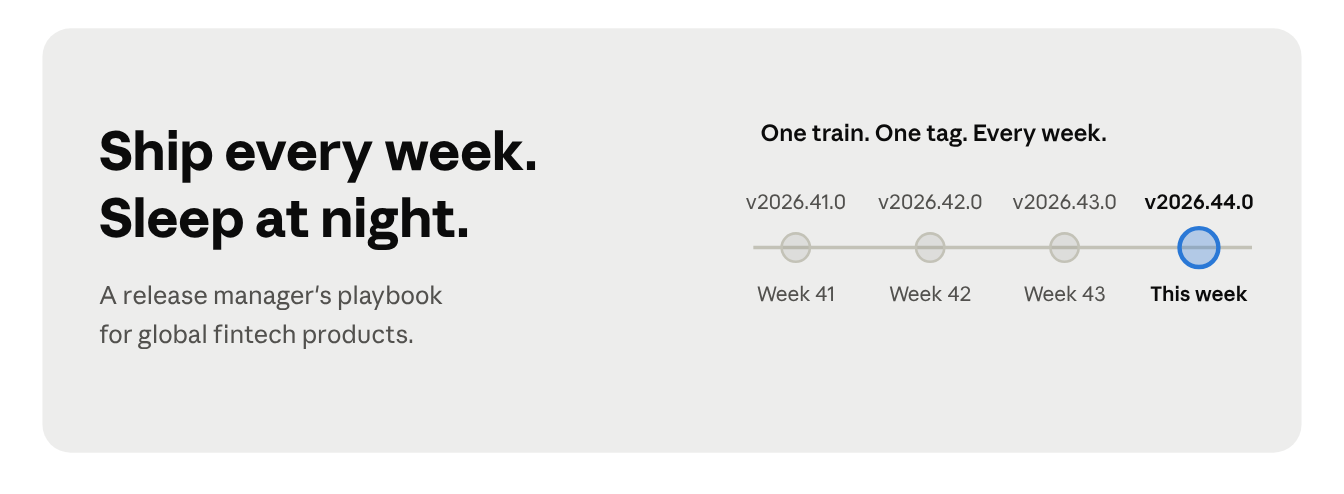
The headline sums up the goal: ship every week and still sleep at night. On the right, each dot is one weekly release tag, and the newest one is highlighted in blue.
Shipping a fintech product every week is like running a train timetable. Changes board on time or wait for the next train. Every release is checked and tested. New features reach one region at a time, so problems stay small.
A global payment product never sleeps. Some customers are always in business hours. Every change touches real money, and regulators watch every step. This playbook is written from a release manager’s point of view. It covers the weekly rhythm, the biggest challenges, and the tools that make weekly releases safe: tags, release notes, deployment support, penny testing, automatic monitoring, and quick feedback.The weekly release train
Meet Tom, the release captain. His team ships every week, like a train timetable: changes board on time or wait for the next train.
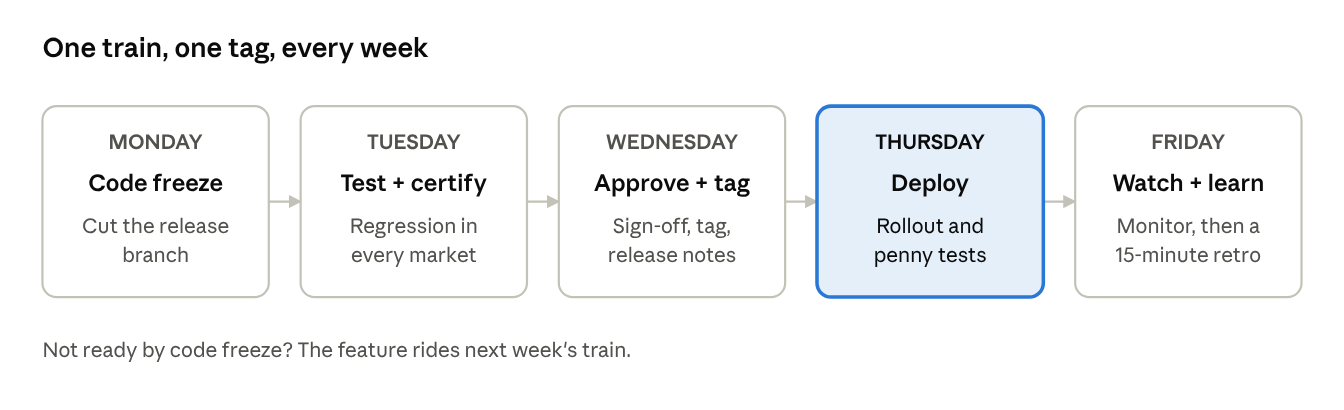
- Five steps through the week: freeze, test, approve and tag, deploy, then watch and learn.
- Every release is checked and tested.
- New features ship switched off.
Read more: The weekly release train
Read the five boxes from Monday to Friday: code freeze, test, approve and tag, deploy (highlighted, because it’s release day), then watch and learn. The note underneath is the golden rule: if a feature misses code freeze, it waits for next week’s train.
Top challenges and how to overcome them
Weekly releases are hard in payments.
- Every time zone is busy, so no hour is safe.
- Money can’t be rolled back once it has settled.
- Compliance, scheme deadlines and testing across markets add pressure.
Read more: Top challenges and how to overcome them
| Challenge | Why it hurts | How to overcome it |
|---|---|---|
| Every time zone is busy | No safe hour exists for a global release | Roll out region by region, follow the sun (hand work to the region that is awake), and set blackout days (no releases) for month-end and local peaks |
| Money can’t be rolled back | A settled payment stays settled | Feature flags (on/off switches), payment calls that are safe to repeat (idempotent), database changes that add new fields before removing old ones, and a plan to fix forward instead of going back |
| Compliance and audit | PCI DSS (security rules for anyone who handles card data), SOX (the US law that makes companies prove their financial records are right) and EU DORA (the EU law that keeps financial firms’ IT systems resilient) rules need proof of control | Log reviews, tests, scans and approvals in the pipeline; pre-approve standard low-risk changes |
| Scheme and partner deadlines | Visa, Mastercard, UPI (India’s instant payments by phone), Pix and SEPA (the euro-area system for bank transfers) set their own dates | Keep a calendar of their required changes (mandates), ship early behind a flag, and book their test (certification) slots early |
| Testing across markets | One change behaves differently by country, currency and payment system (rail) | Automated regression tests (checking old features still work) per market, partner simulators, and canary releases (going live for a small group first) |
| Customers can’t absorb change | Banks and big merchants need notice | Versioned APIs (ways for systems to talk to each other), plain-language release notes, and an early-access sandbox (a practice system to try changes) |
| Incidents | Failed payments mean angry merchants and possible regulator reports | Clear go/no-go rules, watching business numbers like payment success rates, and ready message templates |
| Team fatigue | Late nights across time zones burn people out | Rotate release captains (the person who runs the release), automate the boring steps, and run blameless retros (reviews that look for causes, not culprits) |
Tagging and versioning
Every release gets a clear tag.
- The tag is made of the year, the week number and a patch number.
- Only the pipeline creates tags.
- Tags are signed and never moved or deleted.
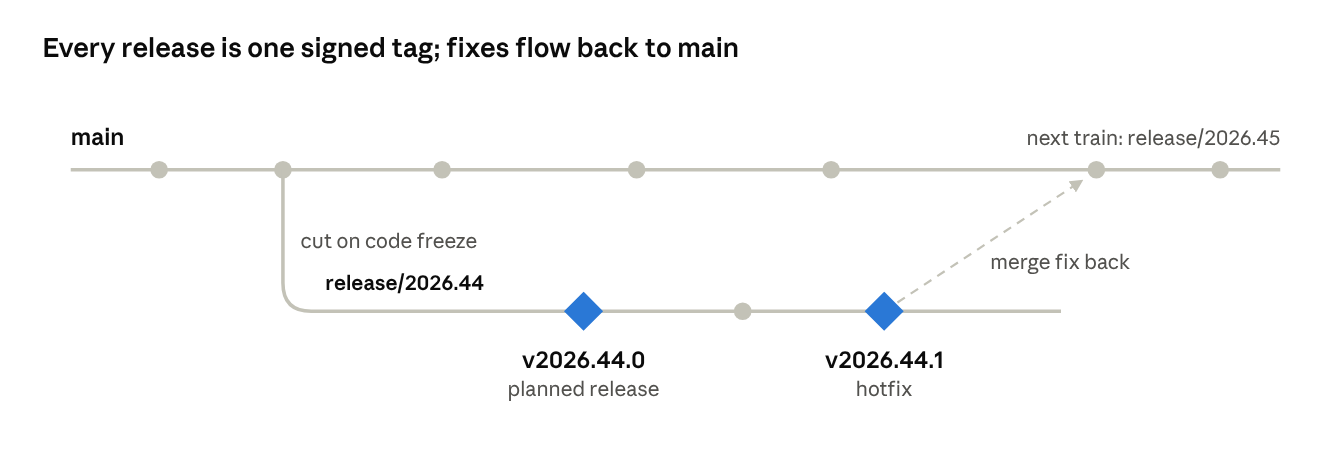
The top line is the main branch. On code freeze day, a release branch is cut below it. The first blue diamond is the planned release tag, and the second is a hotfix. The dashed arrow shows the fix merged back into main, so the next train includes it.
Read more: Tagging and versioning
year.week.patchv2026.44.0v2026.44.1| Tag part | Example | Meaning |
|---|---|---|
| Year | 2026 | Release year |
| Week | 44 | Week number of the year (ISO week) |
| Patch | 0, 1, 2 | 0 = planned release; 1 and up = hotfixes |
- Only the pipeline creates tags, never a person’s laptop.
- Each tag links to its release notes, approvals and test results. That gives auditors one place to look.
For engineers: the technical detail below is optional; the rest of the post makes sense without it.
# Cut the release branch on code freeze day
git checkout -b release/2026.44 main

# Create a signed, annotated tag once tests pass
git tag -s v2026.44.0 -m "Release 2026.44.0 - weekly train"
git push origin v2026.44.0

# Hotfix: fix on the release branch, tag a patch
git tag -s v2026.44.1 -m "Hotfix: EUR refund rounding"
git push origin v2026.44.1Release notes customers actually read
Customers should understand what changed.
- Draft the notes automatically from ticket titles.
- Edit them by hand for customers.
- Publish them in three places, including the developer portal.
Read more: Release notes customers actually read
do I need to do anything?# PayCo Release v2026.44.0
Release date: Thu 29 Oct 2026 (rolling out APAC -> EMEA -> Americas)
## Action required
- None for most customers.
- Brazil merchants: Pix refunds now return a new field, `refund_end_to_end_id`.
Update your parser within two weeks.
## New
- Apple Pay is now available for merchants in Mexico.
- Payouts API: you can now schedule a payout up to 30 days ahead.
## Improved
- Card authorization is faster for EUR payments.
- Dashboard: export disputes to CSV.
## Fixed
- Refund status could show "pending" after success (fixed).
## Compliance
- Updated for the October card scheme release.
## API changes
- API version 2026-10-27 added. Older versions keep working.
## Need help?
Status page: status.payco.example | Support: support@payco.example- Generate the draft automatically from ticket titles and pull requests tied to the tag.
- Edit it by hand for customers. Remove internal ticket numbers and jargon.
- Publish in three places: the developer portal, an email to key customers, and the internal changelog.
Deployment support
On release day, Tom’s crew is ready.
- A release captain, regional on-call engineers, payments ops, support and a compliance contact.
- Start with 1% of traffic in one region, then 25%, then 100%.
- Turn new features on group by group.
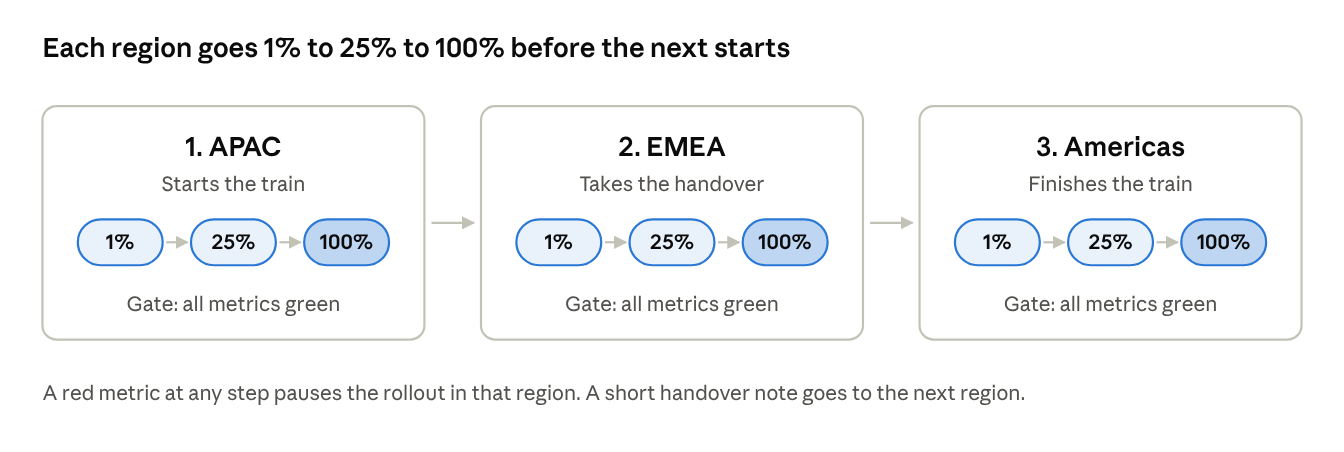
Read the three boxes from left to right. APAC goes first, then EMEA, then the Americas. Inside each box, traffic grows from 1% to 25% to 100%, and only moves on when every metric is green. A red metric at any step pauses that region.
Read more: Deployment support
Release-day roles:| Role | What they do |
|---|---|
| Release captain | Runs the checklist and makes the go/no-go call |
| Regional on-call engineer | Watches the region going live; one per region, in local hours |
| Payments ops | Watches approval rates and partner errors |
| Customer support lead | Ready with message templates for merchants |
| Compliance contact | On standby if a reportable incident happens |
- Tag created and signed; approvals attached
- Release notes published to the developer portal
- Feature flags set to off for new features
- Canary at 1% in the first region; run penny tests (tiny real payments to prove it works); watch for 30 minutes
- Step to 25%, then 100%, if all metrics are green
- Hand over to the next region’s on-call with a short status note
- Turn on feature flags per customer group
- Post the final status in the release channel
Penny testing in production
At 1%, the team sends tiny real payments in each market.
- Company-owned cards and accounts only.
- Check each one end to end, then refund it.
- A failed penny test stops the rollout.
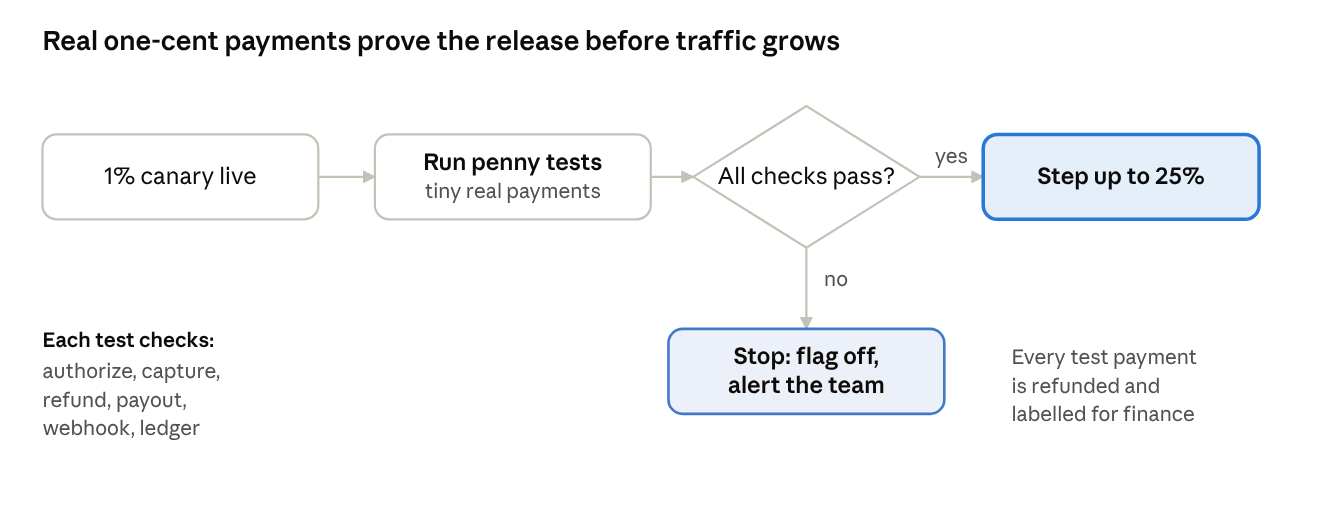
Start on the left with a 1% canary and run tiny real payments. The diamond asks: did every check pass? Yes leads right, to 25%. No leads down to the red box: the feature flag is turned off and the team is alerted.
Read more: Penny testing in production
How to run it:- Use company-owned cards and bank accounts in each market. Never use customer money.
- After the 1% canary is live, run a scripted set of tiny real transactions.
- Check each one end to end: authorization, capture, refund, payout, webhook and ledger entry.
- Refund or void every test payment. Label it so finance can reconcile it.
- Only then step up to 25%. A failed penny test stops the rollout automatically.
| Market | Payment method | Amount | What it proves |
|---|---|---|---|
| United States | Visa credit card | USD 1.00 | Authorize, capture, and refund still work |
| United Kingdom | Faster Payments payout | GBP 0.01 | Payouts arrive and the webhook fires |
| Euro area | SEPA Instant transfer | EUR 0.01 | Credit lands and the ledger matches |
| Brazil | Pix (Brazil’s instant payment system) | BRL 0.01 | Payment and refund, including the new refund field |
| India | UPI | INR 1 | Collect request and refund complete |
- Tag every test transaction with
penny_test=trueand the release tag, such asv2026.44.0. - Leave test transactions out of business dashboards and approval-rate metrics.
- Fund tests from a separate account with a small daily limit.
- Get the penny test plan approved once by compliance and finance, then reuse it every week.
Automatic monitoring and quick feedback
Then the system watches for trouble.
- A drop in approvals, an error spike or slower responses triggers an alert.
- Alerts go to the release channel, not to one person.
- A 15-minute review after every train.
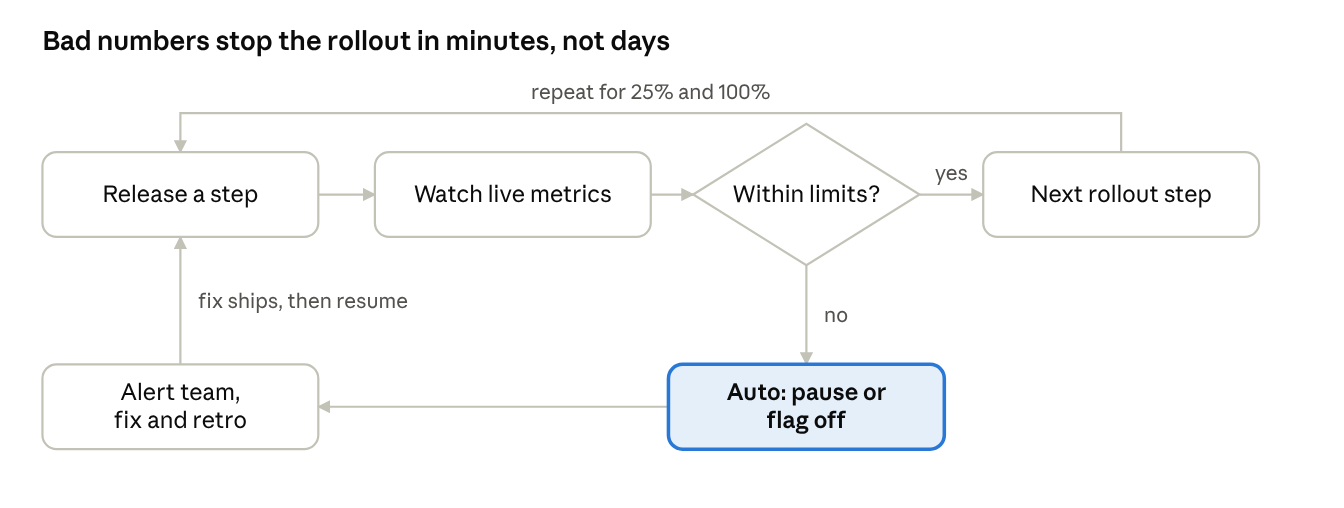
Follow the boxes from left to right: release a step, watch live metrics, and check they are within limits. If yes, move to the next rollout step and repeat. If not, the rollout stops, the fix ships, and then the rollout resumes.
Read more: Automatic monitoring and quick feedback
Example go/no-go thresholds| Signal | Watch window | Auto action if breached |
|---|---|---|
| Payment approval rate drops more than 0.5 points vs last week | 15 min | Pause rollout and alert release captain |
| Error rate above 1% on any payment API | 5 min | Turn the new feature flag off |
| p95 authorization latency up more than 20% | 15 min | Pause rollout |
| Partner or scheme error codes spike | 10 min | Alert payments ops |
| Merchant support tickets jump | 1 hour | Alert support lead and release captain |
- Dashboards that compare this release to the same hour last week, by region.
- Alerts that go to the release channel, not to one person’s inbox.
- Customer signals: support tickets, status-page views and merchant emails, tagged by release.
- A 15-minute retro after every train. What went well, what broke, and one thing to change next week.
Metrics a release manager tracks
Tom tracks a few numbers.
- How often the team ships, and how fast.
- How many releases cause problems, and how fast the team recovers.
- Whether customers’ payment approvals stayed steady.
Read more: Metrics a release manager tracks
| Metric | What it tells you |
|---|---|
| Deployment frequency | Are we really shipping every week? |
| Lead time for changes | How long from code done to live? |
| Change failure rate | How many releases cause a problem? |
| Time to restore | How fast do we recover from a bad release? |
| Approval rate after release | Did customers feel any impact? |
| Trains on time | Does the train leave when planned? |
The bottom line
Speed and safety are not opposites in fintech. Small weekly releases are safer than big quarterly ones, because each change is small, tagged and easy to switch off. A strong release manager builds the system with upstream and downstream: a train that leaves on time, clean tags, clear release notes, staged rollouts and automatic alarms. Then the team ships with confidence, every single week.Working on a payments project?
I help banks and fintechs deliver real-time payments, ISO 20022, and AI-driven AML and compliance change, from strategy to go-live.
Connect on LinkedInSee how I can help