⏱ 3-minute read · open “Read more” for the details
 £ GBP
I spend most of my time on US payments. But when I look at another country, I ask the same three questions. How does money move? Who sets the rules? What protects the customer? Here is how the UK answers them.
In the UK, everyday transfers move in seconds through Faster Payments. Salaries and bills go in batches through Bacs. Large urgent payments go through CHAPS. The Bank of England, the regulators and Pay.UK set the rules.
Part of my Country Payment Guides series. Rules change often, so always confirm with the regulator before you build.
This guide, step by step
- The United Kingdom at a glance
- How people pay in the UK
- How a payment moves in the UK
- Who regulates payments in the UK
- Rules by payment type in the UK
- Data and privacy rules in the UK
- AML, sanctions and fraud checks in the UK
- What is different about the UK
- Before you launch in the UK
Step 1: The United Kingdom at a glance
Imagine your company is launching payments in the UK. Start with the basics.
- Currency: pound sterling.
- Central bank: the Bank of England.
- Instant payments: Faster Payments, since 2008.
Read more: The United Kingdom at a glance
| Fact | Detail |
|---|---|
| Currency | Pound sterling (GBP) |
| Central bank | Bank of England |
| Instant payments | Faster Payments (Pay.UK) |
| High-value payments | CHAPS, settled at the Bank of England |
| Message standard | ISO 20022 (a richer, global format for payment messages) for CHAPS since June 2023 |
Step 2: How people pay in the UK
Next, learn how people in the UK pay.
- Bacs for salaries and Direct Debits.
- Faster Payments for instant transfers.
- CHAPS for large same-day payments; cards for shopping.
Read more: How people pay in the UK
| Payment type | What it is | Speed | Run by |
|---|---|---|---|
| Faster Payments | Instant payments, 24/7, for most everyday transfers | Seconds | Pay.UK |
| Bacs | Direct Debits and Direct Credits such as salaries and bills | Three working days | Pay.UK |
| CHAPS | High-value, same-day payments such as house purchases | Same day | Bank of England |
| Checks | Paper checks, now cleared from a photo and rarely used | Next working day | Pay.UK |
| Cards | Debit and credit, mostly contactless | Seconds to approve | Visa, Mastercard and others |
| Open banking payments | Pay directly from a bank account through an app | Seconds | Licensed apps that start payments from your bank |
When each UK rail started
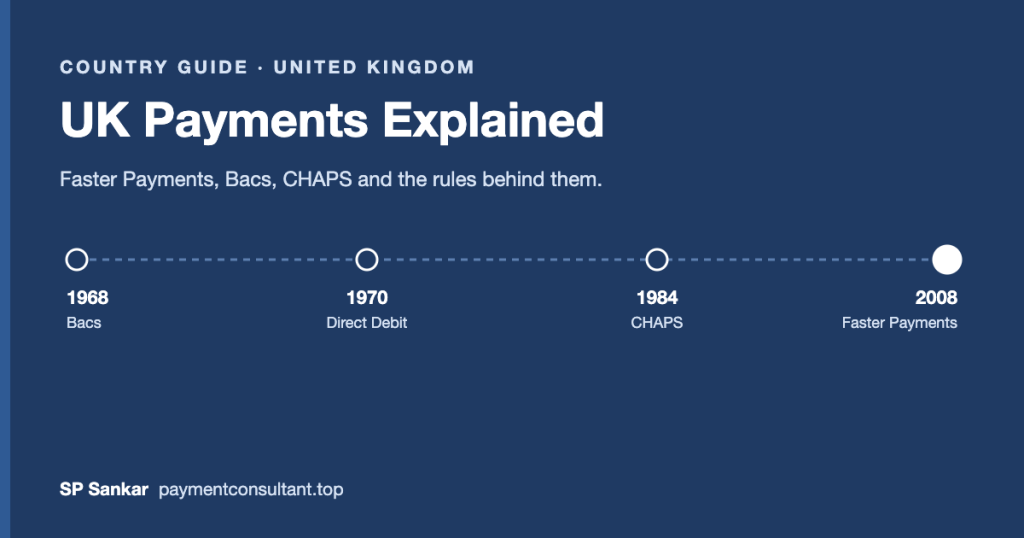
Bacs (1968) and CHAPS (1984) are still the backbone of UK payments. But the UK was also an early instant-payments pioneer. Faster Payments went live in May 2008 and now runs 24/7.
Step 3: How a payment moves in the UK
Here is one Faster Payment’s journey.
- The payer’s bank checks the payee’s name with Confirmation of Payee.
- Faster Payments clears it in seconds.
- Banks settle in central bank money at the Bank of England.
Read more: How a payment moves in the UK
Read the six boxes from left to right. The payer starts the payment and the bank checks it. The payee’s name is checked against the account, called Confirmation of Payee. The payment goes through Faster Payments and settles between banks at the Bank of England. Then the payee is credited. The bar sums up the UK’s scam refund rule.
Step 4: Who regulates payments in the UK
Three bodies share the job.
- The Bank of England runs RTGS and CHAPS, and oversees key systems.
- The FCA licenses firms and protects consumers.
- The Payment Systems Regulator oversees payment systems.
Read more: Who regulates payments in the UK
| Body | Role |
|---|---|
| Bank of England | The central bank: moves money between banks and watches over the most important payment systems |
| PRA | Makes sure banks are financially safe (the Prudential Regulation Authority) |
| FCA | Makes sure firms treat customers fairly, and supervises payment firms and their anti-money-laundering checks (the Financial Conduct Authority) |
| Payment Systems Regulator (PSR) | Oversees payment systems and the scam refund rules; it is being merged into the FCA |
| HM Treasury and OFSI | Sets payment policy and enforces sanctions (bans on dealing with certain people or countries) |
| National Crime Agency | Receives reports from banks about suspicious payments |
Step 5: Rules by payment type in the UK
Each payment type has its own rules.
- The Payment Services Regulations and the Electronic Money Regulations.
- The Direct Debit Guarantee for Bacs.
- Mandatory refunds for most scam victims since October 2024.
Read more: Rules by payment type in the UK
Each way to pay has its own rulebook. This table shows the main laws and scheme rules, who enforces them, and what protects customers. It is a plain-language summary, not legal advice.
| Payment type | Main laws and rules | Who enforces | What protects customers |
|---|---|---|---|
| Faster Payments | Payment Services Regulations 2017; Faster Payments scheme rules; PSR scam reimbursement rules | Pay.UK; FCA; Payment Systems Regulator (PSR) | Scam victims reimbursed up to £85,000 per claim since October 7, 2024; Confirmation of Payee name checks |
| CHAPS | CHAPS Reference Manual and reimbursement rules; Payment Services Regulations 2017 | Bank of England; PSR | Scam reimbursement also applies, up to £85,000 per claim |
| Direct Debit (Bacs) | Direct Debit scheme rules; the Direct Debit Guarantee | Bacs (part of Pay.UK) | Immediate refund from your bank if a payment is taken in error |
| Bacs Direct Credit | Bacs scheme rules; Payment Services Regulations 2017 | Pay.UK; FCA | Banks must help recover payments sent by mistake |
| Credit cards | Consumer Credit Act 1974 (section 75); card scheme chargebacks; UK interchange fee rules | FCA; PSR | Card issuer shares liability for faulty purchases of £100 to £30,000 |
| Debit cards | Payment Services Regulations 2017; card scheme chargebacks | FCA | Maximum £35 liability for unauthorized use, unless you were grossly negligent |
Step 6: Data and privacy rules in the UK
Personal data is well protected.
- UK GDPR and the Data Protection Act 2018.
- Data can leave the UK only with proper safeguards.
- Card data follows PCI DSS.
Read more: Data and privacy rules in the UK
- UK GDPR and the Data Protection Act 2018 protect personal data; the ICO enforces them.
- The Data (Use and Access) Act 2025 updates some data rules, including smart data schemes.
- Data can leave the UK to countries the UK has approved, or with approved safeguards such as the UK’s international data transfer agreement.
- There is no data localization rule for payments data.
Step 7: AML, sanctions and fraud checks in the UK
Every payment is checked for financial crime.
- The Money Laundering Regulations 2017.
- Sanctions screening against the UK sanctions list.
- Confirmation of Payee and scam refunds.
Read more: AML, sanctions and fraud checks in the UK
| Area | What applies |
|---|---|
| AML | Anti-money-laundering laws: banks must check who their customers are, watch payments, and report anything suspicious |
| Sanctions | UK sanctions lists, enforced by OFSI |
| Authentication | Two-step checks when you log in or pay (for example, a code on your phone) |
| APP scam refunds | Since October 7, 2024, most people tricked into sending money to a scammer must be refunded, up to £85,000. The sending and receiving banks split the cost 50/50 |
| Confirmation of Payee | Checks the payee’s name against the account before the payment is sent |
Step 8: What is different about the UK
A few things stand out.
- Instant payments have run since 2008.
- Strong open banking, led by a competition order.
- Scam refunds are shared between the sending and receiving firms.
Read more: What is different about the UK
- Instant payment limits are set by each bank, and are usually much lower than the system’s maximum.
- Bacs takes three working days, so plan Direct Debit dates carefully.
- The PSR is being merged into the FCA. Its current rules, including APP scam refunds, stay in place until they are replaced.
- Variable recurring payments are being extended to more uses. They let an app take regular payments of different amounts straight from your bank.
Because of the APP refund rule, the receiving bank now shares the cost of scams. So checking incoming payments matters as much as checking outgoing ones.
Step 9: Before you launch in the UK
Before you launch, check these.
- Get FCA authorization, or partner with a licensed firm.
- Connect to Faster Payments, Bacs and CHAPS, directly or through a sponsor.
- Build Confirmation of Payee, fraud and AML controls.
Read more: Before you launch in the UK
- Run Confirmation of Payee on every new payee, and show the result clearly.
- Watch incoming payments for “mule” accounts (accounts used to pass on stolen money), not just outgoing ones.
- Plan for the PSR–FCA merger in your compliance roadmap.
- Send full, well-structured details with CHAPS payments.
My take
The UK combines fast payments with strong consumer protection. For payments teams, that means fraud prevention isn’t optional: it’s built into the cost of every payment.Compare the region: see how the UK, the euro area and Switzerland each got to fast payments in Europe Payments Compared.
More country guides
- United States
- Canada
- Mexico
- United Kingdom (you are here)
- Euro area (SEPA)
- Switzerland
- India
- Singapore
- Australia
- New Zealand
- Japan
- China
- Brazil
- Argentina
- Chile
- Colombia
- Peru
- United Arab Emirates
- Saudi Arabia
- South Africa
- Nigeria
- Kenya
Working on a payments project?
I help banks and fintechs deliver real-time payments, ISO 20022, and AI-driven AML and compliance change, from strategy to go-live.
Connect on LinkedInSee how I can help