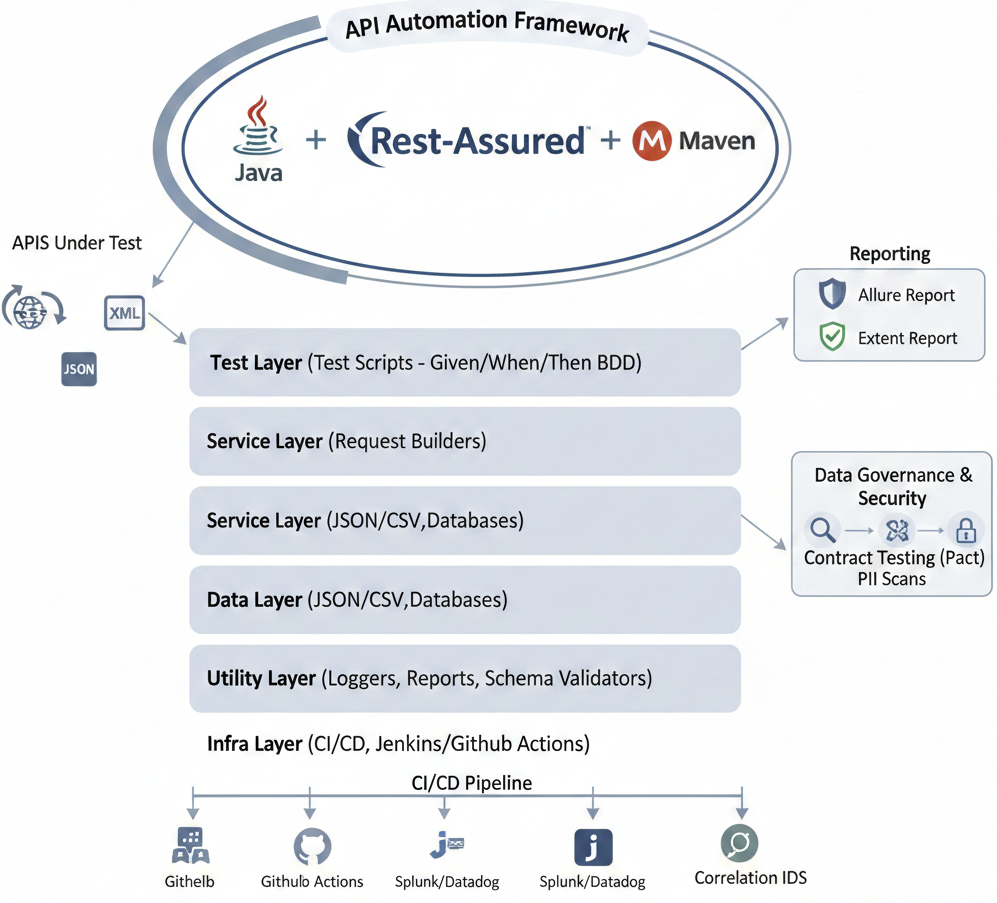
A Rest-Assured + Java + Maven framework is the industry standard for enterprise-level API testing because it combines the power of Java’s object-oriented nature with a syntax that reads like a human sentence.
1. The Core Engine: Rest-Assured
Rest-Assured uses a Domain Specific Language (DSL) based on the Given-When-Then (BDD) format. This makes tests readable for both developers and QA:
-
Given: Set up your request (Headers, Base URI, Authentication, Body).
-
When: The action taken (the HTTPS method:
GET,POST,PUT,DELETE, PATCH). -
Then: The validation of the response (Status codes, JSON body values, response time).
2. The Dependency Manager: Maven (pom.xml)
Maven is the backbone that handles all your libraries. Instead of manually downloading JAR files, you list your dependencies in the pom.xml.
-
Centralized Control: It ensures everyone on the team uses the same version of Rest-Assured, TestNG/JUnit, and Jackson (for JSON parsing).
-
Build Lifecycle: It allows you to run all your tests from the command line (e.g.,
mvn test), which is essential for triggering tests in Jenkins or GitHub Actions.
3. Structural Layers (The “Why” behind the Diagram)
To keep your code clean, a professional framework is split into layers:
-
POJO Layer (Plain Old Java Objects): You convert JSON responses into Java classes. This allows you to use
response.getName()instead of manually parsing a string. This is crucial for Data Governance as it enforces a strict data schema. -
Utilities Layer: This contains reusable code for reading from Excel/JSON files, generating random test data, or handling complex authentication like OAuth2.
-
Reporting Layer: Tools like Allure or Extent Reports take the raw test results and turn them into visual dashboards. They provide the “evidence” needed for compliance audits.
4. A Practical Look: The Workflow
-
Maven downloads the necessary tools.
-
Your Java code creates a request body using a POJO.
-
Rest-Assured sends that body to the API endpoint.
-
Assertions check if the data returned matches the expected governance rules (e.g., checking that PII is masked).
-
Reporting captures the logs and screenshots for the final result.
Key Advantages for Your Role
-
Type Safety: Using Java reduces errors in data handling.
-
CI/CD Ready: It plugs directly into the modern DevOps pipelines used at firms like Capgemini.
-
Extensibility: You can easily add Pact for contract testing to ensure microservices don’t break each other.
How to generate a POM file in 5 Min => https://maven.apache.org/guides/getting-started/maven-in-five-minutes.html