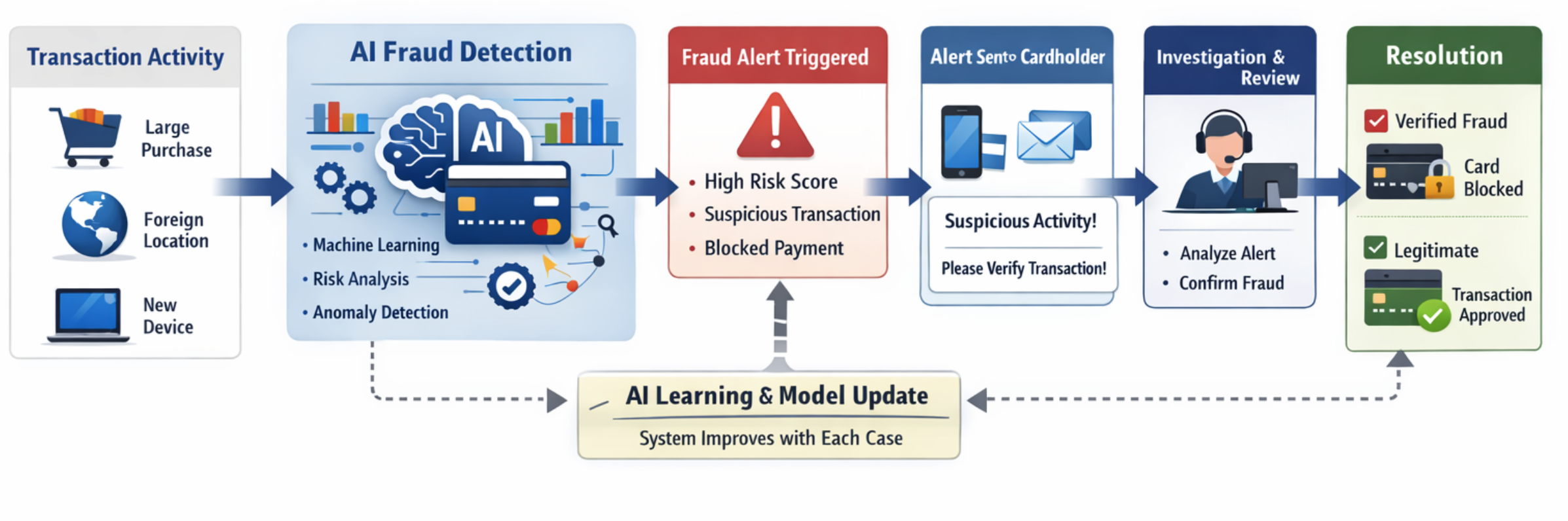
AI systems analyze transactions in real-time to detect suspicious patterns, such as unusual spending, location, or timing. These systems use:
ML Models
Machine learning has transformed how we solve complex problems, from predicting stock prices to detecting fraud. Among the vast array of algorithms, Random Forest and XGBoost have emerged as two of the most powerful tools for structured data. Both are ensemble learning methods, which means they build a “forest” of models to improve accuracy and robustness—but they differ significantly in approach and performance.
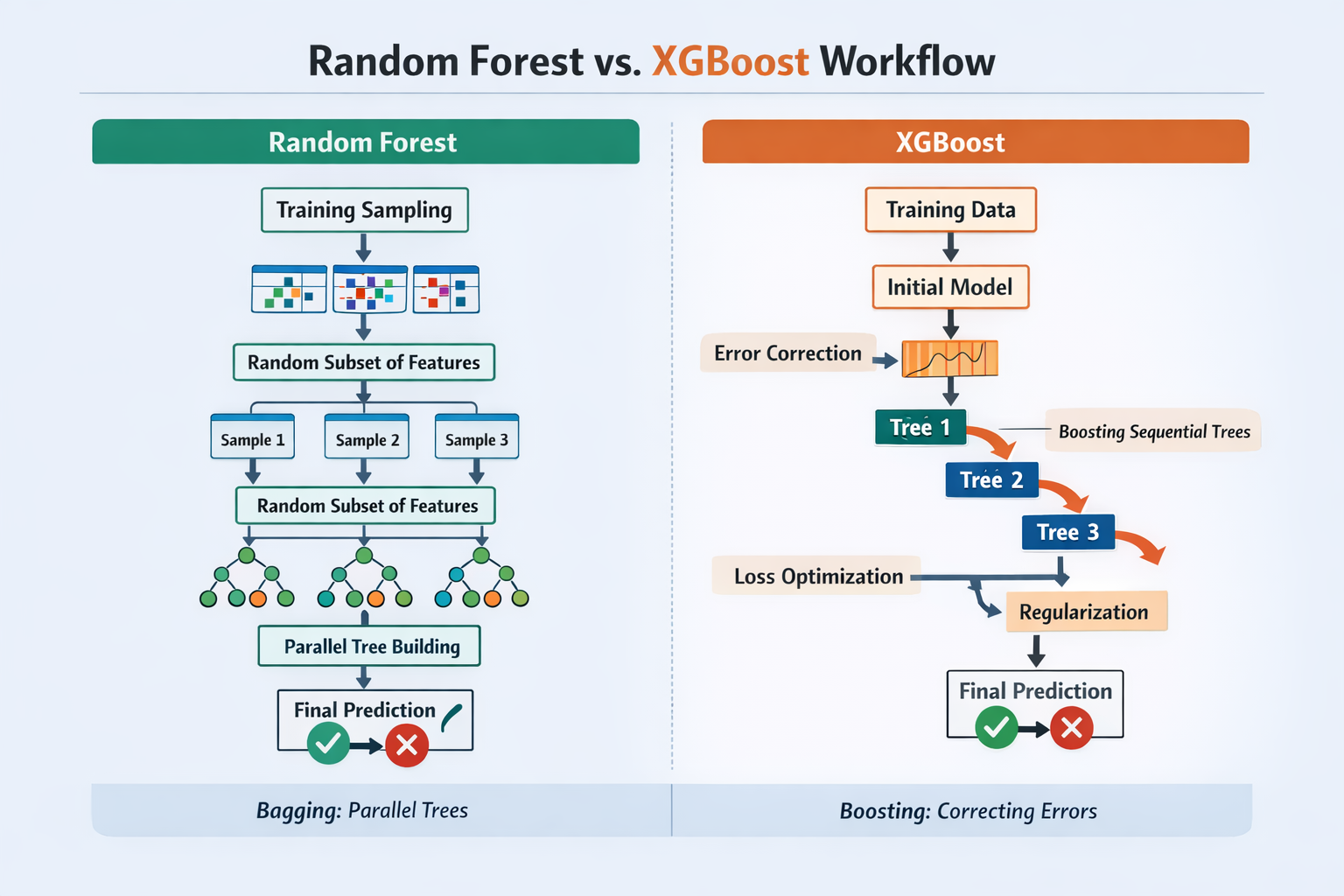
XGBoost (Extreme Gradient Boosting) is a more advanced ensemble technique based on boosting, where models are built sequentially. Each new model focuses on correcting errors made by previous models. XGBoost has gained popularity due to its speed, accuracy, and scalability.
Supervised learning: Trained on historical fraudulent and legitimate transactions.
Unsupervised learning: Detects anomalies without labeled data, tagging, and random outside IPs
Deep learning: Neural networks can detect complex real world scenario, hidden patterns, especially for large-scale transaction datasets and different locations .
Rules based transction: if the transaction is more 1000$ outside of your registration/country. Could temporarily block the transaction, request OTP, or notify the cardholder.
| Feature | Random Forest | XGBoost |
|---|---|---|
| Type | Bagging ensemble | Boosting ensemble |
| Tree Building | Parallel (independent trees) | Sequential (trees correct previous) |
| Overfitting Risk | Lower due to averaging | Moderate; controlled by regularization |
| Performance | Good out-of-the-box | Often higher with hyperparameter tuning |
| Speed | Fast for small to medium datasets | Faster for large datasets with optimizations |
| Interpretability | Medium | Low |