⏱ 5-minute read · open “Read more” for the details
Meet Carlos. He runs a bakery in Chicago. On Friday morning he opens his bank app and pays his flour supplier in Kansas $8,000 by wire. One tap, and the money arrives in minutes. Behind that tap sit about 15 steps and many systems. Let’s follow Carlos’s payment through the bank.
For tech readers: A reference map of a US bank’s payment stack: channels, edge security, payment hub, risk and compliance, core, integration, rails (Fedwire, ACH, RTP, FedNow), back office and exceptions. Use it for discovery, impact analysis and test planning.
- Ask people what happens when they send money and they say “it just goes”.
- A person taps Send, a company uploads a payroll file, or a bank releases a wire through an API (a way for two systems to talk).
- To the sender it is one step.
- Inside the bank it passes about ten layers of systems, in four zones.
- Each layer has one job and one check.
- Know these layers and you know where a payment can stop, who owns each step, and where to look when it breaks.
- This is the map I give anyone new to payments.
- A payment is like a parcel going through an airport.
- It is checked at the door, screened by security, booked onto the right flight, flown, and then counted at the other end.
- Each of the ten layers is one of those stops.
The map at a glance
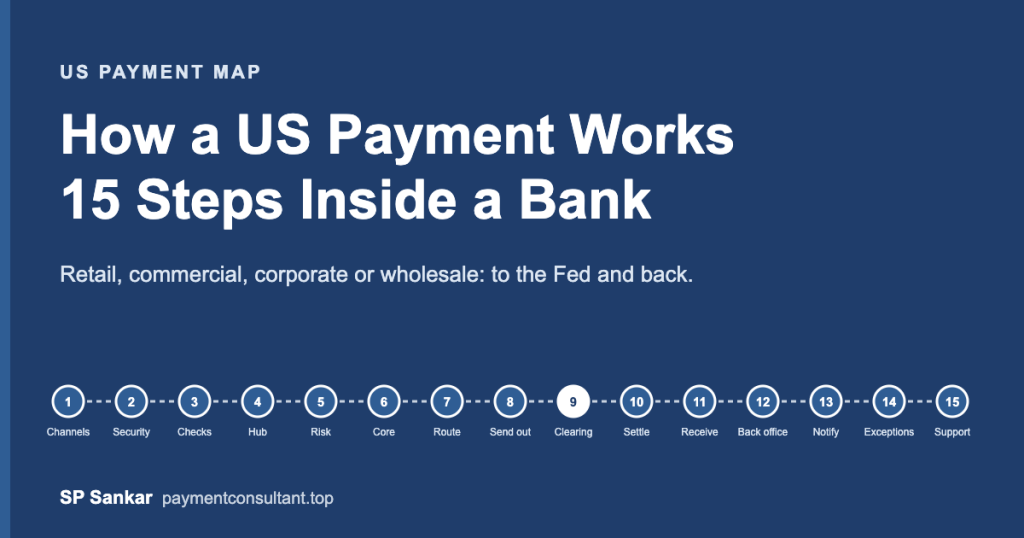
Here is the whole journey on one page. Carlos’s $8,000 passes through 15 numbered steps, from his phone to his supplier’s bank.
- The payment hub sits in the middle and decides the route.
- Every payment leaves the bank on one of three paths: US bank rails, cards and wallets, or cross-border.
- Watch the $ ring move from step 1 to step 15.
(bigger, still animated; scroll or pinch to zoom)
Read more: The map at a glance
Watch the $ ring move from step 1 to 15. The label beside it says what happens at each step. Card, Zelle and PayPal payments use lane 2. Payments abroad use lane 3.
Show the 15 steps as a list
- Channels: the customer starts the payment in an app, a file or an API.
- Edge and security: firewall, API gateway and sign-on check who is calling.
- Channel services: the payee, limits, fees and approvals are checked.
- Payment hub receives it: checks for duplicates and cut-off times.
- Risk and compliance: OFAC sanctions, fraud and AML screening. If it fails, the payment stops here.
- Core banking: checks the money is there and debits the customer’s account.
- Payment hub routes it: picks the rail, for example ACH (bank-to-bank transfers in the US), FedNow, RTP or wire.
- Integration: the rail adapter puts the payment in the rail’s format and sends it over secure network links, out of the bank.
- Clearing operator (outside the bank): ACH uses FedACH or EPN. FedNow and Fedwire use the Federal Reserve. RTP and CHIPS use The Clearing House.
- Settlement: the money moves between the two banks’ accounts at the Federal Reserve.
- Receiving bank: credits the other customer’s account.
- Back office: the status comes back; the bank reconciles, sends advices and reports.
- Customer told: a text, email or push message says the payment is done.
- Only if something goes wrong: returns, recalls, disputes, investigations and complaints are handled here.
- Support, 24/7: monitoring watches every step. Alerts go to L1 (first-line support), then to L2 and L3 (engineers) if needed. See the support section below.
Retail, commercial, corporate and wholesale banking on one map
Carlos is a small business customer. The same bank also serves everyday people, big companies and other banks, all on the same systems.
- Retail: people paying bills and friends.
- Commercial: small and mid-size firms, like Carlos’s bakery.
- Corporate and wholesale: large companies and banks sending big files and wires.
- So one change can affect all four. Test all four.
Read more: Retail, commercial, corporate and wholesale banking on one map
- Most banks serve four kinds of customers.
- They share the same layers but use them differently, so the same system must be built and tested for all four.
- (Here, commercial banking means the bank’s service for small and mid-size businesses.)
| Banking type | Who, and how they pay | What matters most, and the key rules |
|---|---|---|
| Retail banking | Who: people and very small businesses. Payments: card purchases, Zelle, bill pay, instant transfers, direct deposits. Channels: mobile app, online banking, cards, branch. Volume: very many small payments. | Matters: speed, a simple experience, scam and fraud protection. Rules: Regulation E (the US rule that protects consumers’ electronic payments), Regulation Z, UDAAP. |
| Commercial banking | Who: small and mid-size businesses, such as a local manufacturer, a clinic or a chain of shops (each bank sets its own size bands). Payments: payroll, paying suppliers, collecting from customers by ACH, accepting card payments, some wires. Channels: business online and mobile banking, links to payroll and accounting software, a relationship manager. Volume: many mid-size payments and small payroll files. | Matters: cash flow, simple approvals, quick setup, and protection from business email fraud. Rules: Nacha rules and UCC Article 4A. The consumer protections of Regulation E do not cover business accounts. |
| Corporate banking | Who: large companies and multinationals. Payments: large payroll and supplier files by ACH, wires, instant payments, cross-border. Channels: corporate online banking, file upload, host-to-host, APIs and ERP links. Volume: fewer, larger payments, often in bulk files. | Matters: approvals (maker-checker), limits, cutoffs, file handling, and reconciliation (checking that every record matches) for the client. Rules: UCC Article 4A, Nacha rules for businesses. |
| Wholesale banking | Who: other banks, financial institutions, governments and markets. Payments: high-value wires (Fedwire, CHIPS), correspondent banking, treasury and securities settlement. Channels: SWIFT (the secure network banks use to send payments abroad), host-to-host, direct network links. Volume: fewest payments, very high value. | Matters: liquidity, settlement finality, sanctions screening and correspondent due diligence. Rules: Regulation J, CHIPS rules, SWIFT rules, and the BSA (the US law that requires anti-money-laundering checks) with correspondent banking rules. |
Why it matters for delivery: one payment hub change can break a retail app, a payroll run, a corporate file and a wire at the same time. Test each change with a retail, commercial, corporate and wholesale case. Pick release windows that suit all four.
Below, the same systems are grouped into four zones, in the order a payment meets them.
For tech readers: Mobile and online channels reach the bank through an API gateway. Typical controls: OAuth 2.0 / OpenID Connect sign-in, multi-factor, device binding, a web application firewall, bot protection and rate limits.
Zone 1: Customer side
Carlos opens his app, unlocks it with his face and types $8,000. Before anything moves, the bank asks: is this really Carlos, and is he allowed to do this?
- Channels: where a payment starts, such as an app, a website, a file upload or a branch.
- Edge and security: firewalls and sign-in checks stop fake or harmful traffic.
- Channel controls: limits, approvals and payee checks.
Read more: Zone 1: Customer side
Is the request genuine, and is this customer allowed to make it?
Channels
Customers start payments in online and mobile banking, by uploading files, through APIs from their own systems, or at a branch.
The check: Is the instruction complete and in the right format?
Hands on: A clean instruction, often an ISO 20022 pain.001 file for businesses or JSON from apps
Edge and security
Firewalls, DDoS protection, an API gateway, sign-on with multi-factor authentication, and digital signatures for file and API clients.
The check: Is this request really from this customer, and is it safe?
Hands on: A trusted, authenticated request
Channel controls
The customer’s own rules: who may create and who may approve, saved payees, daily limits, fees and approval workflows (maker-checker).
The check: Is this person allowed to send this amount to this payee?
Hands on: An approved instruction
For tech readers: The payment hub validates, enriches and routes each payment and tracks it as a state machine. Idempotency keys stop a double tap from sending twice. Fedwire messages have used ISO 20022 (pacs.008) since July 2025.
Zone 2: Inside the bank
His request reaches the payment hub, the bank’s brain. In under a second, it checks that the payment is correct, safe and funded.
- Payment hub: checks the details and picks the route. For a large, same-day payment, that is a wire.
- Risk and compliance: screens the supplier against watch lists and looks for fraud.
- Core banking: takes $8,000 from Carlos’s account.
- Integration: turns the payment into the right message and sends it out.
Read more: Zone 2: Inside the bank
Is the payment correct, safe and funded?
Payment hub: the brain
Turns every instruction into one standard ISO 20022 payment. Checks for duplicates and cut-offs, holds future-dated payments, fixes missing data, and picks the best rail by amount, speed and cost.
The check: Is it a duplicate, too late, or missing data?
Hands on: A standard payment, routed to the right rail
Why the hub matters: without one, every channel talks to every rail directly. Adding a new rail, such as FedNow, then means changing every channel. With a hub, you change one place.
In less than a second, the bank also checks the supplier against government watch lists and looks for signs of fraud. Is this a new payee? Is the amount unusual for Carlos? Everything looks normal, so the payment moves on.
For tech readers: Real-time sanctions screening (OFAC lists, fuzzy name matching) and fraud scoring (behaviour, device, velocity) run before release. AML monitoring runs after the event. Hits go to a case queue with a service-level target.
Risk and compliance
Every payment is checked against OFAC sanctions lists, scored for fraud, and watched by AML monitoring. Anything suspicious goes to a case queue. Confirmed cases are reported to FinCEN in a suspicious activity report (SAR).
The check: Is it safe and legal to send?
Hands on: Cleared to debit, or held
Now the bank’s main ledger takes $8,000 out of Carlos’s account. His balance changes right away, even though the money hasn’t left the bank yet.
For tech readers: The core posts the debit, often as a hold or memo post first. It books the other side to a suspense or settlement account in the general ledger. Newer cores post in real time; older ones settle in a nightly batch.
Core banking
Checks and holds the funds and debits the account. Posts to the general ledger, using suspense accounts while the payment is in flight. Books any foreign exchange.
The check: Is the money there?
Hands on: Account debited
Integration
An event bus (such as Kafka or MQ) and rail adapters turn the payment into each network’s format. They send it securely, for example over FedLine to the Fed.
The check: Is the message valid for this network?
Hands on: A signed ISO 20022 pacs.008 sent to the rail
External APIs: the outside services the bank depends on
A bank doesn’t build everything itself. Many layers call outside companies through APIs during a payment, usually through the integration layer and an API gateway. If one of them is slow or down, payments can stop, so they need the same care as the bank’s own systems.
| External API | Used by | Example use |
|---|---|---|
| Identity and KYC (checking who the customer is) | Channels and onboarding | Check who a new customer is, using ID documents, data sources and credit bureaus |
| Account validation | Channel services, payment hub | Confirm a payee’s account is open and in their name before sending |
| Fraud and sanctions data | Risk and compliance | Device and behavior signals, consortium fraud data, and the latest OFAC and other sanctions lists |
| FX and market data | Core banking, payment hub | Live exchange rates for cross-border payments |
| Bank directories | Payment hub | Look up routing numbers and which rails a bank can receive on |
| Notifications | Back office, customer care | Send SMS, email and push alerts to customers |
| Partner and open banking APIs | Channels | Let fintechs, ERPs and partners start payments or read data, with the customer’s permission |
Controls for every external API: a vendor risk review and contract first; secure connections, with keys in a vault; timeouts, retries and a fallback; rate limits; only the data the vendor needs; a log of every call; and monitoring of speed and errors.
For tech readers: Fedwire Funds is a real-time gross settlement system. Banks settle in central bank money through their Fed master accounts. Payments are irrevocable and traced by IMAD/OMAD. ACH runs in batches under Nacha rules. RTP and FedNow are instant, 24/7.
Zone 3: Outside the bank
Now the money leaves the bank. Carlos’s wire travels over Fedwire, the Federal Reserve’s system for large payments, and reaches the Kansas bank in minutes.
- US bank rails: ACH for batches, Fedwire and CHIPS for large payments, RTP and FedNow for instant ones.
- Cards, Zelle and PayPal run on networks that sit on top of those rails.
- Payments abroad use SWIFT and may pass through middle banks. Each one adds time and a fee.
Read more: Zone 3: Outside the bank
The payment hub chooses one of three paths: domestic bank rails, card networks and wallets, or cross-border.
Domestic payments: US rails
A payment to another bank inside the US travels on a US rail, chosen by the hub by amount, speed and cost. Settlement happens across the banks’ accounts at the Federal Reserve, and the receiving bank credits the payee.
The check: Does the rail accept the payment, and did settlement complete?
Hands on: A status message such as pacs.002 back to the bank, and the payee credited
Connected to the outside: the bank never moves the money by itself. Its rail adapters connect to an outside operator. For ACH that is FedACH or EPN. For FedNow and Fedwire it is the Federal Reserve. For RTP and CHIPS it is The Clearing House. The operator passes the payment to the receiving bank, and the money settles between the two banks’ accounts at the Fed.
| US rail (type) | Run by | Speed |
|---|---|---|
| ACH Batch | Federal Reserve (FedACH) and The Clearing House (EPN), under Nacha rules | Same day or next day |
| Fedwire Funds Service High value | Federal Reserve Banks | Real time, final when processed |
| CHIPS High value | The Clearing House | Same day, final when released |
| RTP Instant | The Clearing House | Seconds, 24/7 |
| FedNow Instant | Federal Reserve Banks | Seconds, 24/7 |
Also inside the US: cards, Zelle and PayPal
Not every domestic payment goes over a bank rail. Three other networks connect to the same bank systems through the integration layer, each with its own rules and settlement.
| Network, and who runs it | How it connects to the bank | How money settles |
|---|---|---|
| Card networks Run by: Visa, Mastercard, American Express, Discover and US debit networks | Card purchases arrive as authorization requests; the bank’s card system (or its processor) approves or declines in about a second | Clearing files, then net settlement through the network, usually in 1 to 2 days |
| Zelle Run by: Early Warning Services, owned by large US banks | The bank’s app sends to an email or US mobile number; the Zelle network finds the recipient’s bank | The recipient is credited in minutes; banks settle with each other under Zelle network rules |
| PayPal and wallets Run by: PayPal (including Venmo) | PayPal moves money into and out of customers’ bank accounts and cards, often over ACH, cards or instant rails | Inside PayPal’s own balances; the bank sees the ACH, card or instant payment |
P2P in plain words: Zelle vs Venmo, Cash App and PayPal
P2P (person-to-person) means sending money to a friend or family member with just their phone number or email. There are two very different kinds:
| Feature | Bank-led P2P | Wallet-led P2P |
|---|---|---|
| Examples | Zelle | Venmo, PayPal, Cash App |
| Where you send from | Your bank’s own app | A separate app |
| Where the money sits | Goes straight from one bank account to another | Waits in the app’s own balance until you move it to your bank (“cash out”) |
| Speed | Usually minutes | Instant inside the app; moving it to the bank can take a day or two, or be faster for a fee |
| Steps on the map | Steps 1 to 7 as usual, then lane 2 (Zelle network) instead of the clearing house, then the receiving bank | The bank only sees the money going in or coming out, usually as an ACH, card or instant payment |
| Who helps if it goes wrong | Your bank | The app company first, then your bank for the transfer in or out |
The big P2P risk is scams. In most P2P fraud, the customer is tricked into sending the money: a fake seller, a fake “bank” caller or a romance scam. The customer approved it and the money lands in minutes, so it is hard to get back. Banks fight back with warnings for new payees, checks on the receiving account, limits, short delays on risky payments and fast bank-to-bank reports to freeze funds.
For the full Zelle journey, testing and support, see the Zelle payments runbook.
Next month Carlos orders vanilla from a farm in Mexico. This payment crosses a border, so it travels over SWIFT and may pass through one or two middle banks. Each one can take a small fee.
For tech readers: Cross-border payments now use ISO 20022 (pacs.008) on Swift, with a UETR for gpi tracking. Correspondent banks settle via nostro and vostro accounts. Fee options are OUR, SHA or BEN.
Cross-border payments: SWIFT and intermediary banks
A payment to another country goes as a SWIFT message (pacs.008). Most banks don’t hold accounts with every bank in the world. So the payment passes through one or more intermediary banks, also called correspondent banks. These banks hold accounts for other banks and pass the money on, often converting the currency on the way. The last step reaches the beneficiary’s bank abroad. In US dollars, the leg between US banks often settles over CHIPS or Fedwire.
The check: Does each bank in the chain accept it, screen it for sanctions, and pass it on?
Hands on: The beneficiary is credited, minus any fees taken on the way. The bank tracks the payment end to end with its UETR.
Why intermediary banks matter: each one adds time, a fee and its own checks. A payment can get stuck at any of them. Complete data and SWIFT gpi tracking keep it moving.
For tech readers: End-of-day processing reconciles payments against Fed and correspondent statements. It posts to the general ledger, runs regulatory reports and builds customer statements.
Zone 4: After the payment, and when things go wrong
That evening, the back office checks that every dollar sent matches every dollar settled. If a payment goes wrong, people step in.
- Back office: balances the books, files reports and sends statements.
- Exceptions: returns, repairs and investigations when something fails.
- Customer care: tells the customer what happened and what happens next.
Read more: Zone 4: After the payment, and when things go wrong
Did everything balance, and does everyone know?
Back office
Reconciliation matches what the bank sent, what the rail confirmed and what the ledger shows. Customers get advices and notifications (often from camt.054 messages), managers and regulators get reports, and everything is archived for audit.
The check: Does every payment match, to the cent?
Hands on: Reconciled books, reports and an audit trail
One day a payment goes wrong. Carlos typed one digit of his supplier’s account number wrong, and the money comes back. Now people, not just systems, step in.
For tech readers: Rejects and returns arrive as pacs.002 and pacs.004. Investigations and recall requests use camt.056 and camt.029. Failed items go to repair queues with SLA tracking.
Exceptions and customer care: when something goes wrong
Every payment type needs a way to stop it, get money back, investigate it and look after the customer. These systems sit next to the back office and talk to the hub, core banking and the rails.
| Payment type | Stop or get it back | Customer dispute |
|---|---|---|
| ACH | Stop payment before it posts; return or reversal under Nacha rules | Consumers can dispute an unauthorized debit; the bank returns it under Nacha return rules |
| Wires (Fedwire, CHIPS) | Final once sent; only a recall request the receiving bank may refuse | Investigation and recall; fraud reported quickly |
| Instant (RTP, FedNow) | Final in seconds; a return request to the receiving bank | Claims and scam cases; Reg E for unauthorized consumer transfers |
| Cards | Reversal before clearing; refund after | Chargeback through the card network, under network rules and Reg E or Reg Z |
| Zelle | Can’t be cancelled once sent to an enrolled recipient | Claim through the bank under Zelle network rules and Reg E |
| PayPal | Cancel if still pending; refund by the merchant | Dispute in PayPal’s Resolution Center, or a card chargeback |
| Cross-border (SWIFT) | Cancellation request (camt.056) along the chain | Investigation by UETR; Reg E remittance error rules for consumers |
| Checks | Stop payment before the check is paid | Return for fraud or forgery within the deadlines |
Customer issues: every complaint is logged, tracked to a deadline and answered. For consumer accounts, Regulation E sets the clock for error claims. The bank usually has 10 business days to investigate, or up to 45 days if it gives the customer a temporary credit. Regulation Z does the same for credit card billing errors. Complaint trends feed back into product fixes.
Legacy systems: where old and new meet
Carlos’s app looks new, but behind it may sit a core system from the 1980s. Old and new systems work side by side.
- Many banks still run mainframe cores written in COBOL.
- Trouble comes at the hand-overs: format changes, overnight batches and late returns.
- Banks modernize one piece at a time and test old and new together.
Read more: Legacy systems: where old and new meet
- No bank builds this picture in one go.
- Many US banks still run a core system from the 1980s or 1990s, often on a mainframe written in COBOL.
- Newer parts such as FedNow, APIs and real-time fraud scoring are added around it.
The services every layer uses
Some services sit behind every step and watch Carlos’s payment the whole way.
- Monitoring: one view of the payment’s journey, with alerts when something slows down or fails.
- Audit log: who did what, and when.
- Keys and HSMs: encryption keys kept in secure hardware.
Compliance at every layer
Rules don’t live in one team. Each step of Carlos’s payment has its own US rules, and examiners test them step by step.
- Channels: customer protection and secure sign-in.
- Hub and screening: anti-money-laundering and sanctions checks.
- Rails: Nacha rules for ACH, Federal Reserve rules for Fedwire and FedNow.
- Back office: records, reports and audits.
Read more: Compliance at every layer
Compliance is not only layer 5. Each layer carries its own US rules, and an examiner or auditor will test them layer by layer.
| Layer | Main US rules | What it means in practice |
|---|---|---|
| 1. Channels | Regulation E, Remittance Transfer Rule, UDAAP | Clear disclosures, fees and receipts; consumer cross-border transfers show the fee and rate before sending |
| 2. Edge and security | FFIEC authentication guidance, GLBA Safeguards | Multi-factor authentication, protection of customer data, secure connections |
| 3. Channel controls | UCC Article 4A, Nacha rules | A commercially reasonable security procedure for business payments, such as dual approval and callback; fraud checks on online ACH debits |
| 4. Payment hub | Nacha Operating Rules, Federal Reserve operating circulars, RTP rules | Correct formats, cutoffs, returns and time limits for each rail |
| 5. Risk and compliance | Bank Secrecy Act and AML, OFAC sanctions, Travel Rule | Screen every party, monitor for suspicious activity, file SARs, pass originator and beneficiary data on payments of $3,000 or more |
| 6. Core banking | Regulation CC, Regulation E | Funds availability and holds; error resolution and liability limits for consumer accounts |
| 7 to 9. Integration, rails and settlement | Regulation J, Nacha rules, RTP and CHIPS rules, UCC Article 4A | Follow each network’s rules and certification; know when a payment is final and who carries the loss |
| 10. Back office | BSA recordkeeping, Nacha annual audit, SOX controls where they apply | Keep records for the required periods, complete the yearly Nacha Rules compliance audit, and prove reconciliation and change controls |
Tip: keep one control list that maps every rule to the layer and system that enforces it, the owner, and the evidence. It turns an audit from a hunt into a hand-over.
Certification: three simple questions
Before the bank could send Carlos’s wire, someone outside the team had to check its systems and say “yes, it is ready”. It comes down to three questions.
- Can we talk to the network correctly? The Fed, The Clearing House, SWIFT and the card networks test your messages.
- Are our systems and data safe? Think PCI DSS for cards, SWIFT’s yearly security check and valid certificates.
- Can we trust our vendors? Test every release and get yearly SOC reports.
Read more: Certification: three simple questions
Certification just means someone outside your team checks your system and says “yes, it is ready”. For US payments, it answers three simple questions.
1. Can we talk to the payment network correctly? (network certification)
- Before you send real money on a rail, the operator tests your messages with you.
- The Federal Reserve does this for Fedwire, FedACH and FedNow.
- The Clearing House does it for RTP and CHIPS.
- SWIFT does it for cross-border, and Visa, Mastercard and your processor do it for cards.
- You repeat it when you add a new service or the network changes its rules.
2. Are our systems and data safe? (security certification)
Card data needs a PCI DSS assessment every year. SWIFT users attest every year to SWIFT’s security controls. Secure connections need valid certificates, renewed before they expire.
3. Can we trust the software and vendors we use? (vendor certification)
Every vendor release is tested before go-live. Key vendors send a yearly SOC 1 or SOC 2 report from an independent auditor.
| Question | Example | How often |
|---|---|---|
| Can we talk to the network? | FedNow or RTP certification testing | When joining, adding a service, or after network changes |
| Are we safe? | PCI DSS, SWIFT security attestation, certificates | Every year; certificates before they expire |
| Can we trust our vendors? | Vendor release testing, SOC reports | Each release; reports every year |
Tip: put every certification date, certificate expiry and test window on one calendar, next to your release plan. Then nothing surprises you.
For tech readers: Keep a software bill of materials (SBOM, in CycloneDX or SPDX). Run software composition analysis on every build. Enforce a license policy. Rank CVEs with CVSS plus EPSS and the CISA KEV list.
Open source (OSS) compliance, made simple
Carlos never sees it, but his bank’s app is partly built from free code written by others. The bank must know exactly what is inside and keep it safe.
- Keep a list of every building block, called an SBOM.
- Scan every release for known flaws and fix critical ones fast.
- The 2021 log4j flaw showed why: one small tool put thousands of systems at risk.
Read more: Open source (OSS) compliance, made simple
- Building payment software is like cooking with ready-made ingredients.
- Teams use free building blocks made by others, called open source libraries.
- In Java these are JAR files, downloaded by a tool called Maven.
Who fixes it when a payment gets stuck: L1, L2 and L3 support
One day a payment fails and Carlos calls the bank. Support works like a hospital.
- L1 is the front desk: it takes the call and solves simple cases.
- L2 is the doctor: it digs into logs and queues.
- L3 is the specialist: engineers who fix the code.
- Teams in several time zones keep watch 24/7, with extra cover on peak days.
What this means for your team
Each role uses this map in its own way.
- Directors: see risk and spend layer by layer, and fund the weakest spots.
- Product managers: map every feature to the layers it touches.
- Product owners: turn the map into stories with clear acceptance tests.
- Testers and support teams: check every hand-over between layers.
Read more: What this means for your team
Want the delivery and live-support detail for one payment type? Each has its own runbook:
| If you are… | Use the layers to… |
|---|---|
| A director or head of payments | See risk and spend by layer: which layers are legacy, which fail most, which regulatory deadlines are coming (such as ISO 20022), and who owns each one. Fund modernization and resilience where the risk is highest, and make sure every layer has an owner, a runbook and 24/7 cover. Track a few numbers each month: straight-through rate, failed and returned payments, incidents, missed cut-offs and fraud losses |
| A product manager | Map every feature to the layers it touches, and every layer to an owner |
| A product owner | Turn the map into a backlog: write stories for each step and layer, with acceptance criteria for the happy path and for rejects, returns, timeouts and cut-offs. Prioritize fixes that come from support tickets and peak-day reviews, and accept a story only when it has been tested end to end across every layer it touches |
| A developer | Know which layer your code lives in and which systems it calls; make every call idempotent (safe to repeat without doing it twice); log each payment’s ID at every step; handle rejects, returns and timeouts, not just success; and never touch production data directly |
| An AI or machine learning engineer | Know which layer each model serves (fraud scoring and AML in risk and compliance, routing in the hub, chat and case triage in customer care); train on real payment data from those layers; test for speed inside the payment’s time budget, accuracy and bias; log every decision so it can be explained to customers, auditors and regulators; and keep a human in the loop for blocks and complaints |
| A forward deployed engineer (FDE) | Sit with the client’s bank or fintech team, map their real systems onto these layers, connect your product to their hub, core banking and rails, run the pilot payments with them, and bring what you learn back to the product team |
| A DevOps or platform engineer | Build one automated pipeline for every layer: build, security and open source scans, tests and release with no manual steps; deploy without downtime (blue-green or canary) and with a tested rollback (going back to the previous version if something breaks); keep certificates, secrets and keys in a vault with expiry alerts; set up monitoring for each layer; and prove failover to the disaster recovery site works |
| An AIOps engineer | Use AI on the monitoring data from every layer to spot problems before customers do: learn what normal looks like (volumes, response times, rejects, queue sizes), alert on unusual patterns such as a sudden drop in card approvals, link related alerts into one incident, point to the likely cause, and run safe, approved fixes automatically, such as restarting a stuck job, with a payments operations manager approving anything that touches money |
| A tester (QA or quality engineer) | Test the whole journey, not one screen. A payment tester usually covers:
|
| Production support | Find where a payment is stuck by checking each layer’s status in order |
| An architect | Keep each layer’s job narrow, and connect channels to rails only through the hub |
- ACH
- Wires (Fedwire and CHIPS)
- Instant payments (RTP and FedNow)
- Cards
- Checks and remote deposit
- Cross-border over SWIFT
- Zelle
- PayPal
- Embedded payments
For tech readers: Map your own bank’s flow against these four zones. Every handoff between systems is a place to test, to monitor and to name an owner.
What I’d tell any new payments team
Carlos’s $8,000 arrived safely. He tapped once, and about 15 systems and dozens of people made it work.
- A payment is only as safe as its weakest step.
- Every step adds one check that protects the customer’s money.
- Know your layers, give each one an owner and test the hand-overs.
Working on a payments project?
I help banks and fintechs deliver real-time payments, ISO 20022, and AI-driven AML and compliance change, from strategy to go-live.
Connect on LinkedInSee how I can help